
Photo: @joseruigaviao / Ya Gavião
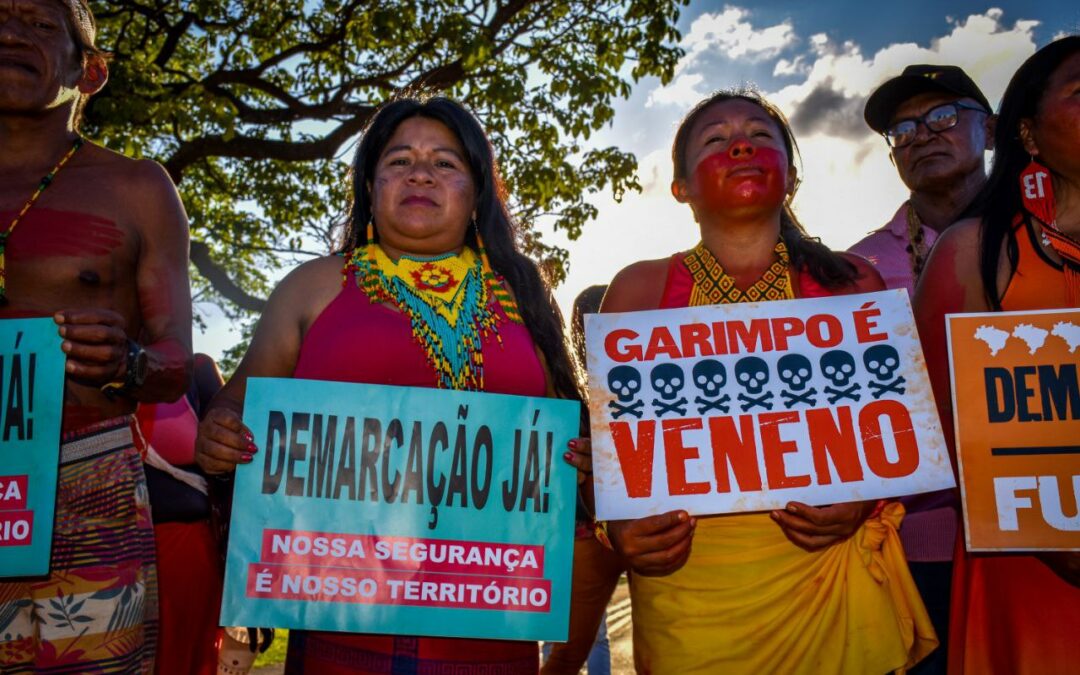
April is considered a month of national mobilization, resistance, and visibility for Indigenous peoples in Brazil. Indigenous April begins with the Free Land Camp (Acampamento Terra Livre – ATL), held in Brasília (DF). ATL 2026 will take place from April 5 to 11 at the Eixo Cultural Ibero-Americano (formerly Funarte), under the theme “Our future is not for sale: we are the answer”. The mobilization is an initiative of the Articulation of Indigenous Peoples of Brazil (APIB).
In its 22nd edition, the program highlights threats to Indigenous territories and Indigenous peoples, while also presenting responses to the climate crisis and the strengthening of democracy. The mobilization is structured around five axes: We Are the Answer; Our Future Is Not for Sale; Our Struggle for Life!; Demarcated Land, Sovereign Brazil and Guaranteed Democracy; and Tell the People to Move Forward!
On April 6, Indigenous leaders from all regions of the country will discuss the violence experienced during the military dictatorship in the plenary session “Memory, Truth and Justice for Indigenous Peoples.” The panel is organized by the Forum on Memory, Truth, Full Reparation, Non-Repetition and Justice for Indigenous Peoples, an initiative aimed at expanding public debate on transitional justice for Indigenous peoples and, above all, at formulating a proposal for the creation of a National Indigenous Truth Commission (CNIV).
On April 7, the program will feature the march “Congress, enemy of the peoples: our future is not for sale.” In 2026, at least six anti-Indigenous proposals are under consideration in the National Congress, such as Constitutional Amendment Proposal (PEC) 48 (Timeframe Thesis – Marco Temporal); Legislative Decrees (PDLs) against land demarcations (717/2024, 1121/2025, 1126/2025 and 1153/2025); the Working Group on Mining in Indigenous Lands; Bill of Law 6050/2023 (Economic Exploitation); and Bill of Law 6093/2023 (Agribusiness Bill).
On April 8, the Indigenous movement will strengthen its engagement in international spaces as part of a political strategy of resistance and articulation, during the plenary session “From traditional territory to the global stage: the Brazilian Indigenous movement in the socio-environmental struggle.” In addition to the panel, APIB will also promote a meeting between Indigenous leaders and embassies, as well as a gathering of Indigenous communicators from Guatemala and Brazil.
On April 9, the 2026 elections will also be part of the discussions at the Free Land Camp, in the panel ‘Indigenous Campaign: we are the answer to transforming politics.’ The plenary will take place that same day and is named after the manifesto published by the Articulation of Indigenous Peoples of Brazil (APIB) last year, which reaffirms the commitment to continue the Indigenous Campaign and the project of ‘indigenizing’ politics. ‘There is no climate agenda without Indigenous political leadership,’ the document states.
April 9 will also feature the march “Demarcate, Lula: a sovereign Brazil is one with demarcated and protected Indigenous lands.” According to APIB, around 76 Indigenous Lands are ready to be ratified and are only awaiting President Lula’s signature as of March this year. Another 34, still depend on the Minister of Justice for the issuance of the declaratory ordinance.
On April 10, the camp’s program will conclude with a plenary session and the reading of the final document. April 5 and 11 will be reserved for the arrival and departure of delegations to and from their territories. Access the full program here: https://apiboficial.org/atl-2026/.
The Articulation of Indigenous Peoples of Brazil (APIB) has launched a fundraising campaign for the camp. To contribute, simply visit www.apiboficial.org/apoie/. Donations can be made by credit card or bank slip (boleto). It is also possible to donate via Pix using the email [email protected] (Articulation of Indigenous Peoples and Organizations of the Northeast, Minas Gerais and Espírito Santo – Bradesco Bank).
About ATL
For 22 years, ATL has brought together thousands of Indigenous leaders from the five regions of the country in the federal capital to denounce rights violations, influence public authorities, and defend their territories.
In 2025, ATL gathered more than 9,000 Indigenous participants in Brasília. With the theme “APIB is all of us: in defense of the Constitution and life,” the mobilization celebrated 20 years of struggle and achievements of the Articulation of Indigenous Peoples of Brazil.
In its final letter, the camp reaffirmed the defense of territorial rights and Indigenous leadership in the global climate agenda. “Our science and ancestral systems, expressed through agroecology, Indigenous economies, collective territorial management, and our spiritual relationship with Mother Nature, preserve biodiversity, all forms of life, including water sources, and sustain healthy and balanced food systems. Therefore, we demand the immediate resumption of the demarcation of all Indigenous lands in Brazil as an effective climate policy, as well as direct funding for the full protection of our territories and ways of life.”
About APIB
The Articulation of Indigenous Peoples of Brazil (APIB) is a national reference body of the Indigenous movement, built from the grassroots. It brings together seven regional Indigenous organizations (Apoinme, ArpinSudeste, ArpinSul, Aty Guasu, Conselho Terena, Coiab, and Comissão Guarani Yvyrupa). It was established to strengthen the unity of Indigenous peoples, coordinate across different regions and organizations, and mobilize against threats and violations of Indigenous rights.
For more information and to schedule interviews, contact:
Email: [email protected]
Phone numbers:
Samela Sateré Mawé, APIB Communications Coordinator: (92) 98285-5077
Yago Kaingang/Fulni-ô, APIB Communications Coordinator: (43) 98868-5501
Ariel Bentes, journalist in the APIB communications and press team: (92) 99430-3762