29/Apr/2017
Indigenous mobilize in record numbers in a display of democracy to the government that works to end native Rights.
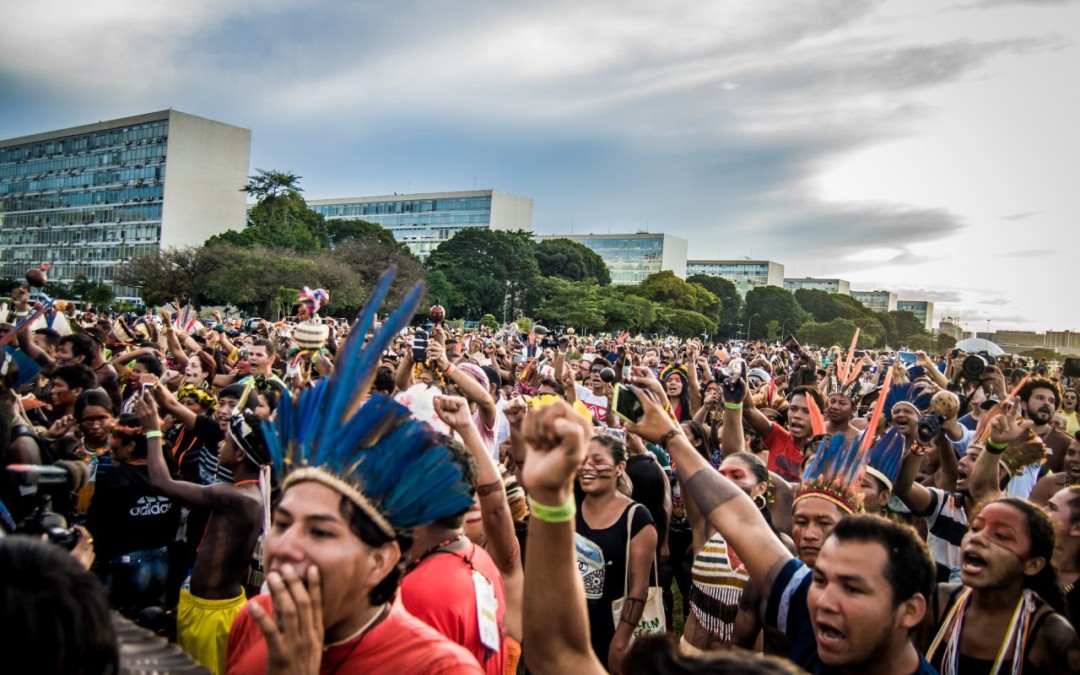
The 14th Free Land Camp (Acampamento Terra Livre – ATL) ended today (4/28) in Brasilia, after days of intense activities and protests. The results were historical. More than four thousand indigenous, originating from 200 communities throughout the entirety of Brazil, were present displaying the force of the indigenous movement. The initial balance was that approximately 1.6 thousand individuals would come the nation’s capital for the event. Today we can observe that this was the largest ATL ever.
“We affirm that we will not tolerate violence, loss of rights or threats perpetrated by the Brazilian State and by economic oligarchs acting against our lives and our rights. We also call upon all of the Brazilian society as well as the international community to join the fight of the original peoples in defending traditional territories and mother nature, for the good of all living beings” states the camp’s final document.

Photo: Mídia Ninja / MNI
The document was received by the Federal House and the Ministries of Education, Health and Justice. The indigenous movement, however, has refused to participate in meetings requested by the Minister of Justice, Osmar Serraglio, and by the Government’s Chief of Staff, Eliseu Padilha. The two are ruralist politicians and the main proponents of measures against indigenous rights within the Federal Government.
Throughout the week, also due to pressures caused by the mobilization, the National Indigenous Fund (Funai) published reports identifying four Indigenous Lands belonging to the Guarani people, one in Paraty (RJ) and another three in Vale do Ribeiro, in São Paulo, as well as one land of the Pipipã people, in Pernambuco. All in all, the areas represent territories corresponding to 70 thousand hectares.
The Brazilian indigenous movement has consolidated unity on its fight and has been forming an international alliance with indigenous leaderships of six countries (Panama, Costa Rica, Guatemala, Ecuador, Bolivia and Indonesia). It has strengthened protagonism among indigenous women and youth and has received support from other social movements in the country. It has also disseminated indigenous culture and its demands like never before, leaving a tough message for the Temer government: “we do not accept attacks on the rights of original peoples.”

Ana Terra Yawalapiti. Photo: Mídia Ninja / MNI
Over the last four days, work groups discussed, among other themes, the pause in demarcation of indigenous lands; the weakening of public policies and institutions supporting indigenous issues; anti-indigenous legislation being proposed in Congress; the “Time Frame” thesis which considers indigenous lands to be only those that were controlled by indigenous communities at the time the Constitution was promulgated (on October 5th, 1988).
Coverage of the camp made by indigenous communicators and partners reached 8.5 million people on social networks throughout the week on the movement’s official page alone. National and international press disseminated the march of thousands of indigenous in Ministries’ Esplanade, main access to government buildings in Brasilia, and published images of the “Demarcation Now” image on banners held up high in front of Congress. Today, the world is more aware of the plight of indigenous peoples in Brazil.
At the beginning of the week, a music video was released showcasing the participation of more than 25 renowned Brazilian artists which was entitled “Demarcation Now”. In the video were artists such as Maria Bethania, Gilberto Gil, Ney Matogrosso, Chico César, Carlos Rennó, Lenine, Nando Reis, Zeca Baleiro, Letícia Sabatella, Elza Soares, Zeca Pagodinho, among others.

Katãn Kaingang baby. Photo: Luíza Calagian / MNI
The ATL also taught a lesson in democracy to the Temer government. On Tuesday (4/25), on its first march of the week, indigenous were received with teargas and rubber bullets in front of Congress. On the next day, they were prohibited from entering the Senate to watch a public hearing and were intimidated by police on the way to and from the camp. In spite of this, on Thursday (4/27) the indigenous held another peaceful march in the center of Brasilia to show their indignation with the treathening and the loss of rights.
For all this motives, the 14th Free Land Camp was a milestone in the fight for and defense of indigenous rights. And the fight goes on.

20/Apr/2017
There are only a few days left for the beginning of the Free Land Camp 2017. The entire program aims to bring together in a large assembly leaders of indigenous peoples and organizations from all regions of Brazil to discuss and position themselves on the violation of the constitutional indigenous rights and the anti-indigenous policies of the brazilian State. Check out the complete grid:
Monday (April 24th)
9am – Free Conference on Women’s Health
Location: Indigenous Peoples’ Memorial
9am/6pm – Presidents of CONDISI Forum
Location: SESAI – 510 North
6pm – Dinner
Location: ATL
7pm – Opening Plenary
Location: ATL
8:30pm – Documentary: ‘Preconstituinte’
9pm – Publication Launch (Unified Report): UN special Rapporteur to the indigenous people; Rapporteur about indigenous rights (Dhesca Platform) and parallel Report to the RPU.
Location: ATL
10:30pm – Surprise artistic presentation
Location: ATL
**All day: Delegations arrival and camp set up
Tuesday (April 25th)
6am/8:30 am – Cultural Activities: singing, dancing and body painting
Location: Delegation tent
7am – Breakfast
Location: ATL
8am – Opening Plenary – welcoming dancing and singing
Location: Main tent
8:30am – Opening Plenary with traditional leaders from the 5 regions
9am/1pm – Seminar “Indigenous Peoples and Original Rights”
Location: Ministério Público Federal
10am – Debate on threats to indigenous rights in the three branches of government
Location: ATL
- Executive Power: Deconstructing the institutions and public policies directed to indigenous people (the paralyzation of demarcation, the dismantling of Funai and Sesai, decrees, etc.).
Participants: Weibe Tapeba and Adriana Ramos
- Legislative Power: anti-indigenous legislative initiatives (Inquiry Parliamentary Commission – CPI; Law Proposals – LP; Constitutional Amendment Proposals – CAP; Legislative Decree Proposals – LDP).
Participants: Sônia Guajajara and Maurício Guetta.
- Judiciary System: “Time Frame” thesis, judicialized demarcation processes; Repossessions of Property; denial of Access to Justice rights; criminalization of leadership.
Participants: Valéria Buriti and Adelar Cupsinski
1pm/2pm – Lunch
Location: ATL
3pm – Guidance for the march
3:30pm – March / National Congress Act
6pm – Dinner
Location: ATL
6pm/7pm – Terra Livre Audiovisual show
7pm/8pm – Monologue Theatre Piece: Gavião de Duas Cabeças
8pm – Indigenous Women Plenary with Angela Kaxuyana and Samanta Xavante
11pm – Cultural Activities
Wednesday (April 26th)
6am/8:30 am – Cultural Activities: singing, dancing and body painting
Location: Delegation tent
7am – Breakfast
Location: ATL
7:30am – General Plenary – welcoming, dancing and singing
Location: Main tent
8am – Plenary: Themed Work Groups Guidance
Moderator: Ceiça Pitaguari and Marivelton Baré
9am – Themed Work Groups
* Indigenous Lands and Territories (land situation, indigenous land demarcation)
* Enterprises that impact indigenous territories (Right to consultation and Free, Prior and Informed Consent (FPIC), consultation of community protocols).
* “Time Frame” thesis; right to access justice; indigenous communities and the criminalization of leaders
* Indigenous Health / Indigenous Health Special Secretary (SESAI): background, current situation of the special policy and prospects.
* Indigenous School Education: past, current and prospective situation of the special policy
* Indigenous legislative proposal, national and international (Law Proposals – LP, Constitutional Amendment Proposals – CAP, International Treaties).
Note: In addressing the themes, consider the basic text of the ATL and the proposals deliberated by the First National Conference of Indigenous Peoples (I CNPI).
12am – Lunch
2pm/3:30pm – Plenary: sharing the conclusions of the Themed Groups
Moderator: Dinaman Tuxá and Nara Baré
3:30pm/6:30pm – Debate and ways forward
Note: Invited participants for the plenary: government authorities; members of the Parliament; Jurists and MPF representatives (participants in the Seminar “Indigenous Peoples and Original Rights”).
External
2pm – Public Hearing at the CDH of the Federal Senate, with the participation of a commission of 80 to 100 leaders representing the ATL.
** Table: Kretan Kaingang; Lindomar Terena; Eliseu Lopes; Paulinho Guarani; Paulo Tupiniquim; Sônia Guajajara and Darã Tupi-Guarani
Location: Federal Senate
6pm – Dinner
6pm/9pm – Terra Livre Audiovisual Show
9pm – ‘Demarcação Já’ Concert with indigenous and non indigenous people
Thursday (April 27th)
6am/8h30am – Cultural Activities: singing, dancing and body painting
Location: Delegation tent
7am – Breakfast
8am – General Plenary welcoming dancing and singing
Location: Main tent
8:30am/9:30am – Plenary: “Unify the fights in defense of indigenous Brazil”, with the presence of representatives from urban and rural organizations and social movements.
9:30am/4:30pm – Plenary: “International mobilization and unification of the indigenous peoples fights”, with the presence of APIB indigenous leadership and international indigenous movements.
10h30am/11h30am – Approval of the Conclusions of the Women’s Free Conference
11:30am/12:30am – ATL Final Document
12:30am – Lunch
3pm – March and Demonstration to the Ministries of Environment, Health, Justice and Education, besides Planalto Palace, to file the Final Document of the ATL.
4pm/6pm – Hearings and filing of the Final Document of the ATL and other texts in the offices of the STF Ministers.
6pm – Dinner
6pm – Maracatu
7pm – Terra Livre Audiovisual Show
Movie: Movie Martyrdom
Friday (April 28th)
6am/8h30am – Cultural Activities: singing, dancing and body painting
Location: Delegation tent
7am – Breakfast
8am – General Plenary – welcoming, dancing and singing
Location: Main tent
9am – General Strike: integration with social movements
12am – Final referrals
Additional activities:
1. Meeting of indigenous parliamentarians, mayors and vice-mayors
2. Meetings of indigenous communicators.
3. Meetings of indigenous lawyers.
4. Meetings of Women and Indigenous Youth
5. Other joint meetings.
6. Shows: audiovisual, musical and other cultural and artistic manifestations.
Note: Complementary activities should take place at times other than plenary sessions, working groups, marches and demonstrations, preferably during ATL evenings.