18/Oct/2026
In Yerevan, the Brazilian Indigenous movement will advocate for turning global biodiversity commitments into action through territorial demarcation and protection, Indigenous participation in decision-making, direct access to funding, and guarantees of Free, Prior and Informed Consent (FPIC).
From October 19 to 30, the Articulation of Indigenous Peoples of Brazil (APIB) will be in Yerevan, Armenia, to participate in the 17th Conference of the Parties to the Convention on Biological Diversity (COP 17). APIB will bring the priorities developed by the Brazilian Indigenous movement for the protection of biodiversity and Indigenous Peoples’ rights to international negotiation and advocacy spaces.
COP 17 will conduct the first global review of progress in implementing and monitoring the Kunming-Montreal Global Biodiversity Framework. For APIB, this review must demonstrate whether international commitments are effectively reaching Indigenous territories, strengthening rights, and ensuring the conditions necessary for Indigenous Peoples to continue fulfilling their historic role in biodiversity conservation.
As with the climate and desertification agendas, APIB will argue that biodiversity loss cannot be addressed without guaranteeing the territorial rights of the Peoples who have historically protected it.
Indigenous territories at the heart of biodiversity policy
Land demarcation, protection, the removal of illegal occupants, and territorial governance must be recognized as fundamental conditions for achieving biodiversity conservation, restoration, and sustainable-use targets.
The position presented at COP 17 calls for Indigenous territories to be recognized as strategic areas for achieving global targets and for Free, Prior and Informed Consent (FPIC) to be guaranteed in territorial planning, licensing, the establishment and management of protected areas, mining, infrastructure projects, and other initiatives that may affect these territories.
One of the central debates will concern the implementation of Targets 2 and 3 of the Global Biodiversity Framework, which address restoration and area-based conservation. APIB will advocate for the recognition of Indigenous and Traditional Territories as a distinct conservation category, respecting their systems of governance, self-government, and self-determination, without subordinating them to the conventional framework of protected areas or Other Effective Area-based Conservation Measures (OECMs).
COP 16, held in Cali in 2024, made progress by incorporating indicators related to Indigenous Peoples’ land use and tenure into the Global Biodiversity Framework’s monitoring mechanism. However, it did not establish clear, binding commitments on territorial demarcation and protection.
For APIB, it is not enough to count conserved areas: it is necessary to recognize who protects these territories, guarantee their rights, and ensure their participation in decision-making.
Indigenous participation must mean decision-making power
Another strategic issue at COP 17 will be the functioning of the new Subsidiary Body on Article 8(j) and Other Provisions of the Convention, established at COP 16.
Article 8(j) recognizes the importance of the knowledge, practices, and ways of life of Indigenous Peoples and local communities for biodiversity conservation and sustainable use. The creation of a permanent body dedicated to this issue represents progress toward Indigenous participation in the Convention.
In Yerevan, negotiations will address the body’s functioning, implementation of its Programme of Work through 2030, and guidelines related to Targets 2 and 3. APIB will advocate for these spaces to ensure the direct, meaningful, and effective participation of representative Indigenous organizations, with a genuine capacity to influence countries’ multilateral decisions.
Indigenous knowledge must not be treated merely as a tool for achieving conservation targets. It is intrinsically connected to territories, cultures, ways of life, and Indigenous governance systems and must be protected alongside the rights of the Peoples who hold it.
Funding must reach territories directly
Biodiversity financing will be another central pillar of APIB’s participation.
The Global Biodiversity Framework calls for the mobilization of US$200 billion per year. For APIB, however, increasing the volume of funding is not enough if Indigenous organizations continue to face bureaucratic mechanisms and intermediaries when trying to access it.
Our organization will advocate for Indigenous Peoples to move beyond the role of end beneficiaries of projects designed by third parties and exercise leadership in the design, governance, implementation, and monitoring of resources allocated to conservation and territorial protection. This position aligns with the direct-financing agenda that APIB has been advancing internationally.
At the same time, APIB warns of the risks associated with the financialization of nature, particularly through offsetting mechanisms and biodiversity credits that may turn the diversity of life into economic assets without addressing the structural causes of its destruction.
Biodiversity financing must mean new resources that are accessible and directly available to Indigenous territories, with transparency, safeguards, social oversight, and respect for collective rights.
Biodiversity, traditional knowledge, and the Cali Fund
APIB will also follow negotiations on Digital Sequence Information (DSI) on genetic resources.
The growing use of digitized genetic information poses risks when such data are separated from the territories and Peoples from which they originate. For APIB, digitizing biodiversity must not erase its territorial origins, associated traditional knowledge, or the rights of its custodians.
Free, Prior and Informed Consent, traceability, and the fair and equitable sharing of benefits must therefore remain at the center of negotiations.
At COP 16, the Cali Fund was established in connection with benefit-sharing from the use of DSI, with provisions for directing resources to Indigenous Peoples and local communities in developing countries.
At COP 17, APIB will advocate for the operationalization of this mechanism to ensure that a substantial share of its resources reaches Indigenous territories and maretórios directly, accessibly, and without excessive bureaucracy. Maretórios refers to Indigenous territories and traditional spaces of life and livelihood associated with marine and coastal environments.
There can be no biodiversity protection without rights
The biodiversity agenda cannot be separated from the climate crisis and territorial conflicts.
APIB has been warning about the impacts of expanding agribusiness, mining, infrastructure, and other economic activities on Indigenous Lands and strategic ecosystems. The agenda developed for COP 17 itself identifies these pressures among the main threats to the implementation of the Global Biodiversity Framework.
Similarly, the transition to a low-carbon economy must not create new sacrifice zones. The expansion of mining for critical or strategic minerals, when carried out without territorial protection and FPIC, may reproduce the historical violations associated with previous cycles of economic exploitation.
In Yerevan, APIB will convey a central message: there can be no lasting solution to biodiversity loss without guaranteed rights.
Global conservation targets cannot be established while Indigenous territories remain under threat. Indigenous knowledge cannot be recognized without ensuring that its Peoples participate in decision-making. And billions cannot be mobilized for biodiversity while Indigenous organizations continue to face barriers to accessing those resources directly.
APIB’s participation in COP 17 reaffirms an agenda built from Indigenous territories and carried into international forums: territorial demarcation and protection, self-government and self-determination, Free, Prior and Informed Consent, direct financing, protection of traditional knowledge, fair benefit-sharing, and Indigenous participation with genuine decision-making power.
Protecting biodiversity means protecting territories. And protecting territories means guaranteeing the rights of Indigenous Peoples.
26/Aug/2026
During the 17th Conference of the Parties to the United Nations Convention to Combat Desertification (COP17), held in Mongolia, APIB, together with APOINME (our grassroots political organization), hosted the panel “Indigenous perspectives on desertification: pathways to address land degradation and prolonged drought in Brazilian biomes”.
The event presented Indigenous perspectives on the spread of desertification and land degradation, as well as the effects of prolonged droughts on Brazilian biomes. The discussion focused particularly on the impacts on Indigenous territories, which face increasing pressure from deforestation, land grabbing, mining, the expansion of commodity supply chains, and the exploitation of water and other natural resources.
The panel was moderated by Danilo Tupinikim (APIB) and featured Bárbara Tupinikim, representing the Articulation of Indigenous Peoples and Organizations of the Northeast, Minas Gerais, and Espírito Santo (APOINME); Rute Anacé, from the Ministry of Indigenous Peoples (MPI); and Onel Inanadinia Masardule, a consultant for the International Indian Treaty Council.
Throughout the dialogue, participants emphasized that addressing desertification cannot be limited to technical or environmental solutions. For Indigenous peoples, this is also an agenda concerning rights, climate justice, territorial protection, and historical reparation.
Territorial degradation directly affects water sources, food production, biodiversity, and the continuity of traditional ways of life, knowledge, and practices. These impacts are exacerbated by economic activities that encroach upon biomes without respecting the territorial rights, cultures, and autonomy of Indigenous peoples. Among the pathways presented during the panel are the demarcation and effective protection of Indigenous lands, the strengthening of Indigenous territorial and environmental management, the provision of direct funding to Indigenous peoples, and the guarantee of consultation and free, prior, and informed consent regarding measures and projects that could affect their territories.
The panel also highlighted the need for traceability across all stages of commodity supply chains and the accountability of companies and economic activities involved in biome degradation and the violation of Indigenous rights.
The event brought together representatives from governments, Indigenous organizations, and civil society, as well as negotiators, researchers, funders, and international bodies involved in developing responses to desertification, drought, and land degradation.
By bringing these perspectives to COP17, the panelists shared the voices of Indigenous peoples, reaffirming that we should not be recognized merely as populations affected by the environmental crisis. Traditional knowledge, management practices, and distinct forms of territorial governance are essential for protecting water resources, restoring ecosystems, and building just, lasting responses to the climate crisis.
Strengthening the rights and leadership of Indigenous peoples is indispensable to tackling desertification and securing the world’s future.
18/Aug/2026
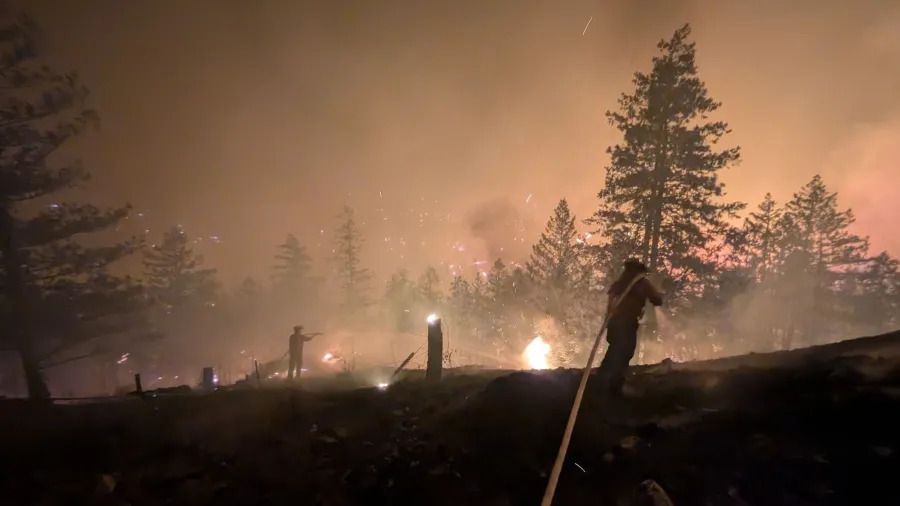
The Articulation of Indigenous Peoples of Brazil (APIB) expresses its solidarity with the Indigenous Peoples and communities affected by the wildfires occurring across different regions of Canada, whose effects are also being felt in the United States.
Thousands of people have been forced to leave their homes and territories as the fires spread. For Indigenous Peoples, forced displacement from their territories disrupts community life, access to food and medicine, cultural and spiritual practices, and their daily connection to the land.
The climate crisis is worsening this situation and exposing a reality shared by Indigenous Peoples across different territories: we are among the first to face its impacts, even though our territories, knowledge, and ways of life play a fundamental role in protecting the forests and maintaining the planet’s balance.
APIB also stands with Indigenous leaders in their calls for rapid and coordinated emergency responses, adequate support for displaced people, resources for community reconstruction, and greater participation by First Nations in fire prevention and response.
From Brazil to Canada, our realities are distinct, but our roots and struggles are ancestrally connected.
Solidarity among our peoples transcends borders and strengthens a common struggle for the protection of our territories, for self-determination, and for climate justice.
To our relatives in the affected regions, we send our strength, our respect, and our solidarity.
17/Aug/2026
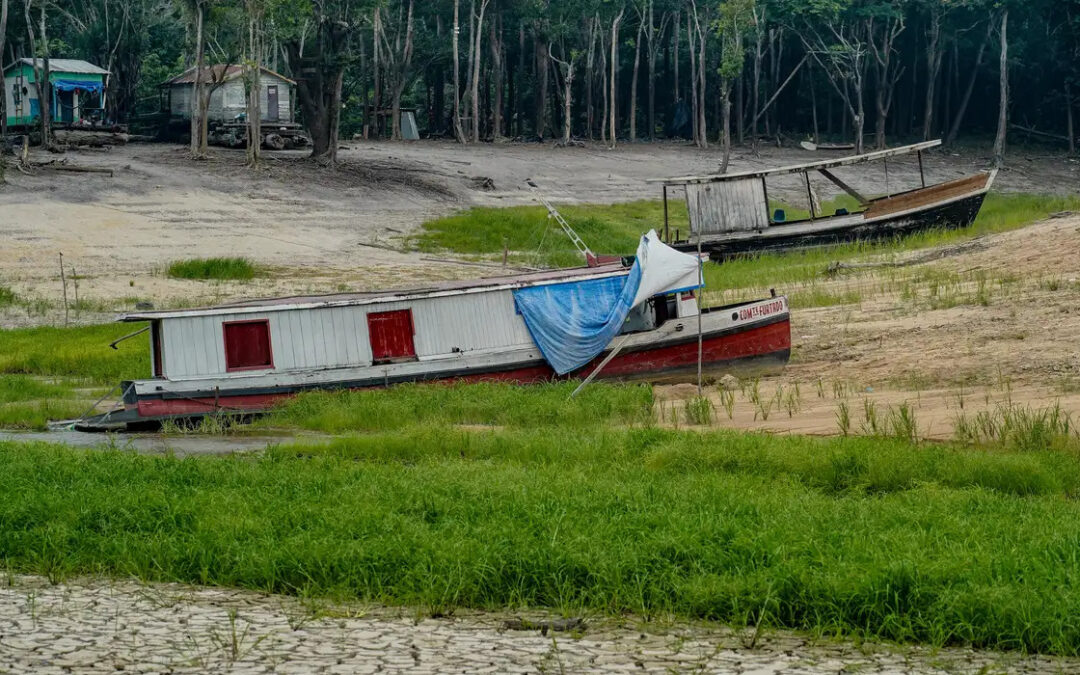
The Articulation of Indigenous Peoples of Brazil (APIB) will participate in the 17th Session of the Conference of the Parties to the United Nations Convention to Combat Desertification (COP17), to be held from August 17 to 28, 2026, in Ulaanbaatar, Mongolia. The organization will bring the perspectives, demands and proposals of Indigenous Peoples in Brazil to the international debate on addressing desertification, land degradation and drought.
APIB’s participation is grounded in the recognition that Indigenous Peoples are among those most directly affected by environmental degradation processes and the effects of prolonged droughts. Across different Brazilian biomes, Indigenous territories are affected by deforestation, land grabbing, mining, the expansion of commodity production chains, and pressure on water resources and traditional ways of life.
These processes threaten not only ecosystems, but also water sources, food sovereignty, biodiversity, traditional knowledge, cultural practices and the very continuity of Indigenous Peoples’ ways of life.
For APIB, addressing desertification cannot be treated solely as a technical or environmental agenda. It is also an agenda of Indigenous rights, climate justice, territorial protection and historical reparation.
In this regard, the demarcation and protection of Indigenous territories, the strengthening of Indigenous territorial and environmental management, direct financing for Indigenous Peoples, the guarantee of free, prior and informed consultation and consent (FPIC), traceability throughout commodity production chains, and accountability for economic activities that degrade biomes are key measures to address land degradation, drought and the impacts of the climate crisis.
Side Event at the Brazil Pavilion
During COP17, APIB, in partnership with its indigenous regional organization, the Articulation of Indigenous Peoples and Organizations of the Northeast, Minas Gerais and Espírito Santo (APOINME), will hold a side event at the Brazil Pavilion, located at C2 in the Blue Zone.
The event will take place on August 19, from 5:00 to 6:00 p.m. (local time), under the title:
Indigenous Perspectives on Desertification: Pathways to Address Land Degradation and Prolonged Drought in Brazil’s Biomes.
The panel will bring together Indigenous leaders from Brazil to discuss the advance of desertification and the effects of drought across Brazilian biomes from the perspectives of Indigenous Peoples, with particular attention to impacts on Indigenous territories and traditional ways of life.
The event will seek to affirm that combating desertification requires responses that go beyond exclusively technical or environmental approaches. The protection of territories, the guarantee of Indigenous rights, and the strengthening of Indigenous forms of territorial and environmental management are fundamental elements for addressing biome degradation and building effective responses to the climate crisis.
The panel will also address measures such as direct financing for Indigenous Peoples, the guarantee of free, prior and informed consultation and consent (FPIC), traceability throughout commodity production chains, and accountability for economic activities that contribute to environmental degradation.
The event will be aimed at government representatives, negotiators, civil society organizations, academics, funders, international organizations and other stakeholders involved in developing responses to desertification, drought and land degradation.
APIB’s participation in COP17 reaffirms that there can be no effective action against desertification without Indigenous rights, nor climate justice without the protection of Indigenous territories.
07/Aug/2026
Brasília, August 3, 2026
The Articulation of Indigenous Peoples of Brazil (APIB), a national organization composed of indigenous organizations from different regions of the country, alerts the international community to the escalating threats to the territorial rights of indigenous peoples in Brazil.
This week, the Federal Supreme Court (STF), the highest body of the Brazilian judiciary, will resume decisive landmark hearings on the so-called “Time Frame Thesis” (“Marco Temporal”) and Federal Law No. 14,701/2023. At the same time, proposals are moving forward in the National Congress to suspend already completed land demarcations and weaken the legal framework governing the recognition of Indigenous lands.
This scenario represents a legal and political conflict marked by a coordinated offensive that threatens hundreds of Indigenous Peoples, increases insecurity and violence against Indigenous communities, and undermines the protection of biodiversity and efforts to address the climate crisis.
The “Time Frame Thesis” is a legal doctrine according to which Indigenous Peoples would only be entitled to the demarcation of lands they were physically occupying on October 5, 1988 — the date the current Brazilian Constitution was enacted — or lands for which they could prove the existence of an ongoing legal dispute or persistent conflict on that date.
This thesis disregards the fact that countless Indigenous Peoples were expelled from their ancestral territories before 1988 due to state actions, economic ventures, armed violence, persecution, forced removals, and historical processes of colonization. In many cases, these communities were unable to seek judicial protection or safely return to the lands from which they had been removed.
In 2023, when ruling on the case involving the Xokleng People of the Ibirama-Laklãnõ Indigenous Territory, the Federal Supreme Court (STF) held that the Time Frame Thesis was unconstitutional. The Court recognized that Indigenous Peoples’ rights to their traditional lands are original — that is, rights that predate the very formation of the Brazilian State — and that the demarcation process merely identifies and officially declares a pre-existing right.
Despite this ruling, the National Congress enacted Federal Law No. 14,701/2023, which attempted to reinstate the Time Frame Thesis and introduced several restrictions on the demarcation, protection, and exclusive use of Indigenous Lands. The law was passed without taking into account all the impacts on Indigenous Peoples, territories, and the environment, as repeatedly pointed out by the Indigenous organizations.
The Time Frame Thesis was rejected, but its effects persist.
In December 2025, the Brazilian Federal Supreme Court (STF) once again formally rejected the Time Frame Thesis. However, it upheld significant portions of Law No. 14,701/2023 and established rules that may delay — or even prevent — the effective restitution of Indigenous ancestral territories to their rightful peoples.
Among these measures are the expansion of compensation for non-Indigenous occupants, allowing such occupants to remain on Indigenous lands until compensation is payed, permitting the allocation of alternative territories, creating new administrative obstacles to the demarcation process, and imposing sanctions on Indigenous communities that undertake the reoccupation (“retomadas”) of their traditional territories.
APIB refers to this process as the material deconstitutionalization of Indigenous rights. Although Article 231 of the Brazilian Constitution remains formally in force, its effectiveness is being undermined by judicial interpretations and administrative rules that make it increasingly difficult for Indigenous Peoples to secure recognition and protection of their traditional territories.
In practice, the restitution of traditional lands is no longer a clear priority; budgetary constraints and administrative delays now condition the demarcation process; non-Indigenous occupants receive expanded procedural protections; and the Indigenous communities’ efforts to reclaim their ancestral territories after decades of state inaction are increasingly treated as unlawful acts.
It is unacceptable for ndigenous Peoples to be penalized for the Brazilian State’s own, failure to comply with the constitutional five-year deadline — counting from the promulgation of the 1988 Brazilian Constitution— to complete the demarcation of all Indigenous lands.
Appeals related to General Repercussion Theme No. 1,031— the procedural mechanism created by the Federal Supreme Court to organize and group cases addressing the same legal or constitutional question — and the constitutional challenges to Law No. 14,701/2023 are expected to be heard jointly by the STF. The hearing is scheduled to take place between August 7 and 18, 2026, initially through the Court’s virtual plenary system.
The Court’s decision may have far-reaching consequences for hundreds of Indigenous land demarcations and territorial disputes across Brazil. APIB advocates that the case should be heard in the STF’s in-person plenary chamber, ensuring public scrutiny and the effective participation of Indigenous peoples.
There is also growing concern that exceptional measures — such as granting an alternative area or provinding financial compensation instead of restoring the traditional territory — might come to be treated as standard solutions in Indigenous land demarcation proceedings.
Precedents from the Inter-American Human Rights System establish that alternative remedies may only be considered in truly exceptional circumstances, supported by compelling evidence and subject to effective consultation with, and the consent of the affected Indigenous People. The primary remedy must remain the restitution of the traditional territory.
Another serious setback is the attempt to equal indigenous land reclaims (“retomadas”) with ordinary property invasions or trespassing.
Retomadas are collective processes through which Indigenous Peoples return to portions of their traditional territories following expulsions, violence, and decades of state neglect. They cannot be analyzed according to a purely civil or commercial logic of property. The rules upheld by the STF allow for expedited evictions, police operations, and administrative sanctions against Indigenous communities that undertake land reclaims. Among the sanctions is the possibility of moving the respective demarcation process to the end of the administrative queue.
Punishing an Indigenous community for attempting to return to the territory from which it was historically removed means shifting the consequences of state violence and inaction onto the victims.
The situation of the Aldeia Velha Indigenous Territory, home to the Pataxó People, in the municipality of Porto Seguro, in the state of Bahia, demonstrates that the effects of the Time Frame Thesis are far from abstract.
Although the territory completed the administrative demarcation process and has been ratified by the federal government, a legal dispute initiated by private interests has come to threaten the continued presence of Indigenous families across a substantial portion of the territory.
Arguments related to Law No. 14,701/2023 and the “Time Frame Thesis” were used to challenge the territory and justify an eviction order against approximately 650 families, which corresponds to about 2,000 Indigenous people. The disputed area represents more than half of the officially demarcated Indigenous territory.
The territory includes homes, a school, a health clinic, archaeological sites, mangrove ecosystems, and preserved areas of the Atlantic Forest. The attempt to remove the Pataxó people from their ancestral territory is taking place in a region marked by intense real estate speculation and the rapid economic appreciation in the value of coastal land.
The case illustrates a particularly dangerous consequence of the Time Frame Law: allowing companies, landowners, and other private interests to reopen disputes over Indigenous territories that have already undergone technical studies, administrative recognition, and formal ratification.
Thus, not even the formal conclusion of the demarcation process has been sufficient to guarantee territorial security for the communities.
A similar situation affects the Manoki Indigenous Territory in the state of Mato Grosso, where the territorial expansion process has likewise been challenged based on grounds of the absence of Indigenous occupation of the relevant area in 1988. These cases demonstrate that a legal doctrine previously declared unconstitutional continues to be invoked to suspend actions by the Executive Branch and threaten already-recognized territories.
The offensive is also advancing in the Brazilian National Congress:
Legislative Decree Bill No. 717/2024 seeks to annul the presidential ratification of the Toldo Imbu and Morro dos Cavalos Indigenous Lands in the state of Santa Catarina. Furthermore, it aims to suspend key provisions of Decree No. 1,775/1996, which regulates the administrative demarcation procedure of Indigenous lands in Brazil.
The bill has already been approved by the Federal Senate, and its expedited legislative procedure was approved by the Chamber of Deputies, allowing it to be submitted directly to the plenary without going through the relevant standing committees. Since it is a legislative decree bill, its eventual final approval will not require presidential sanction.
The threat, therefore, is not limited to these two territories. The suspension of Decree No. 1,775/1996 would undermine the legal framework used to identify, demarcate, and recognize Indigenous lands throughout the country, creating a ripple effect on demarcation proceedings at various stages.
Brazil is thus facing simultaneous attacks on Indigenous land demarcation through both legislative and judicial branches.
Indigenous territories are not merely physical spaces. They guarantee the collective existence of Indigenous Peoples, the transmission of knowledge, languages, and cultural practices, as well as food security, spirituality, self-determination, and the continuity of future generations.
The demarcation of Indigenous lands is also one of the most effective measures for curbing deforestation, protecting biodiversity, and addressing the climate emergency.
The Inter-American Court of Human Rights, in its Advisory Opinion No. 32/2025 on the Climate Emergency and Human Rights, recognized the particular vulnerability of Indigenous Peoples in the face of the climate crisis, the crucial role of their territories in conservation and climate change mitigation, and the States’obligation to provide them with enhanced protection.
In this context, territorial demarcation of Indigenous lands must be understood simultaneously as a historical redress and as a measure to protect life, self-determination, biodiversity, and the climate.
Weakening Indigenous territorial rights means facilitating the spread of land grabbing, the illegal exploitation of natural resources, deforestation, mining, predatory agribusiness, and real estate speculation.
It also means putting Indigenous peoples in isolation and those in initial contact at risk, as their territories remain vulnerable to invasions, wildfires, deforestation, and forced contact.
Call to the International Community
Given the gravity of the situation, APIB calls upon States, multilateral organizations, international human rights mechanisms, financial institutions, foundations, civil society organizations, and allies of Indigenous peoples to:
- closely monitor the trial scheduled for August 2026 and its effects on Indigenous territorial rights;
- express concern over any judicial decision or legislative measure that weakens the protection established by Article 231 of the Brazilian Constitution;
- advocate for the restitution of traditional territory as a priority obligation of the Brazilian State;
- reject the criminalization of land reclaiming efforts (“retomadas”) and of Indigenous human rights defenders;
- demand respect for the right to consultation and to free, prior, and informed consent (FPIC);
- monitor the progress of Legislative Decree Bill (PDL) No. 717/2024 and other legislative initiatives aimed at annulling Indigenous land demarcations or weakening the demarcation process;
- support the physical, legal, and political protection of threatened Indigenous communities and leaders; and
- ensure that financing, investments, and supply chains are not linked to the invasion, exploitation, or legal contestation of Indigenous territories.
The international community cannot treat events in Brazil as an exclusively domestic matter. The country has both constitutional and international obligations to protect Indigenous peoples and their territories.
Although the Time Frame Thesis was declared unconstitutional, its underlying rationale continues to be used to halt demarcation processes, criminalize Indigenous communities, reopen disputes over territories that have already beem officially recognized, and protect private economic interests.
APIB reaffirms that Indigenous Peoples’ original rights cannot be subject to an arbitrary date, traded in exchange for other territories, or conditioned upon payments compensating those who benefited from expulsions and land titlings promoted by the State itself.
There is no solution to the climate crisis without Indigenous peoples. There is no protection of biodiversity without securing our territories. And there is no democracy as long as the constitutional rights of Indigenous peoples remain subject to setbacks.
The Indigenous movement’s response will continue to be mobilization, advocacy, and resistance.
Our time frame is ancestral. We have always been here.
Articulation of Indigenous Peoples of Brazil (APIB)
07/May/2026
The Articulation of Indigenous Peoples of Brazil (APIB), an organization representing more than 300 indigenous peoples from all regions of Brazil at both national and international levels, reaffirms its support for the immediate implementation of the European Union Deforestation Regulation (EUDR), understood as an additional instrument to address rights violations occurring in our territories, beyond deforestation alone. The EUDR represents an important step forward as it addresses the problem from the demand side, holding supply chains and consumer markets accountable for benefiting from environmental destruction and violence against Indigenous peoples. In the context of the European Union’s ongoing review of the EUDR, it is essential to recall that this regulation constitutes a key instrument for promoting respect for human rights, Indigenous peoples’ rights, and environmental protection at a global scale. Any attempt to weaken or dilute its provisions poses a direct threat to indigenous territories and ways of life.
The successive postponements of the EUDR’s entry into force—initially scheduled for December 2024 and subsequently delayed to 2025 and 2026—have serious consequences for indigenous territories and other traditional communities in Brazil and worldwide. The gradual weakening of the regulation, combined with the acceleration of negotiations on the Mercosur–European Union Agreement and the dismantling of mechanisms such as the Amazon Soy Moratorium, increases pressure on the territories, encourages speculative agribusiness expansion, and fuels the invasion of Indigenous lands. In this context, we urge European institutions and Member States to ensure the effective implementation of the EUDR in 2026, without further delays or setbacks.
Agribusiness remains the primary driver of invasions of Indigenous lands in Brazil. Cattle ranching accounts for more than half of the total area of Indigenous lands invaded by the sector, followed by soy production, revealing the direct link between the international commodities trade, deforestation, and human rights violations. In 2024, conflicts related to territorial rights totaled 154 cases across 114 Indigenous Lands in 19 states, while land invasions, illegal exploitation of natural resources, and other forms of damage affected 159 Indigenous Lands in 21 states across the country (CIMI, 2025, p. 8)*.
APIB warns that pressure on these territories is not limited to the Amazon. The displacement of deforestation and the expansion of the agricultural frontier into other biomes – such as the Cerrado, Pantanal, Pampa, and Caatinga – is already a reality. The Cerrado, for example, has experienced accelerated deforestation precisely due to increased pressure on the Amazon. This dynamic intensifies territorial conflicts, escalates violence, and deepens the vulnerability of indigenous peoples living in regions historically affected by the expansion of soy, livestock, mining, and large-scale infrastructure projects.
For this reason, APIB advocates for the broad application of the EUDR, covering all Brazilian biomes and not only forest areas. It is essential that the regulation considers all native vegetation and prevents the mere displacement of destruction from one territory to another. Even with the law’s current focus restricted to forested areas, it is essential to ensure the legality of land occupation, respect for human rights, and the protection of indigenous territories across all properties linked to commodity production—not only those associated with recent deforestation. It is also necessary to expand the scope of the regulation to include additional commodities, supply chains, and minerals, such as gold, and to strengthen traceability mechanisms capable of identifying the entire production chain, down to the originating farms and enterprises.
In this regard, traceability mechanisms must be comprehensive, transparent, and mandatory, ensuring full traceability to the origin of production. Without this, loopholes persist that enable the “laundering” of commodities originating from areas linked to rights violations, thereby undermining the effectiveness of the regulation and the accountability of involved actors.
Tracking deforestation alone is not sufficient. Mechanisms must also ensure the identification and accountability of companies involved in illegal activities and crimes such as human rights violations, forced displacement of communities, violence against Indigenous leaders, territorial invasions, precarious labor conditions, pesticide contamination, and the destruction of ways of life—across all areas of origin and in all biomes, without exception.APIB also advocates that the EUDR’s monitoring and reporting systems include the effective participation of Indigenous peoples, ensuring they are transparent, accessible, secure, and subject to social oversight. Our peoples already monitor their territories and must be provided with the technical and financial support necessary to strengthen their capacity for advocacy and reporting.
APIB acknowledges that the current Brazilian government has made international commitments related to combating deforestation, climate change, and the protection of indigenous rights. However, these commitments must be translated into concrete domestic policies. There will be no international credibility if Brazil continues to allow the weakening of environmental licensing, the promotion of the Marco Temporal thesis, the expansion of mining in Indigenous lands, the opening of new oil and gas frontiers, and the advancement of large-scale projects over our territories.
In light of this scenario, APIB reaffirms its support for the EUDR and its implementation without further delays or weakening. We advocate for a development model based on the defense of human rights, solidarity among peoples, the protection of territories, and the protection of biodiversity.
There is no climate justice without the full protection of Indigenous territories. There is no sustainable development when peoples are sacrificed in the name of profit. The rights of Indigenous peoples are not bargaining chips in trade negotiations and commercial operations.
APIB will remain mobilized, denouncing violations and building national and international alliances, to affirm that Indigenous territories are on the front line of defending life, the climate, and the future of humanity, and cannot continue to be treated as sacrifice zones.
* Report “Violence Against Indigenous Peoples in Brazil – 2024 Data” by the Missionary Council for Indigenous Peoples (CIMI). Available at: <Relatório Violência Contra os Povos Indígenas no Brasil – Dados de 2024>.
Articulation of Indigenous Peoples of Brazil (APIB)
03/Apr/2026
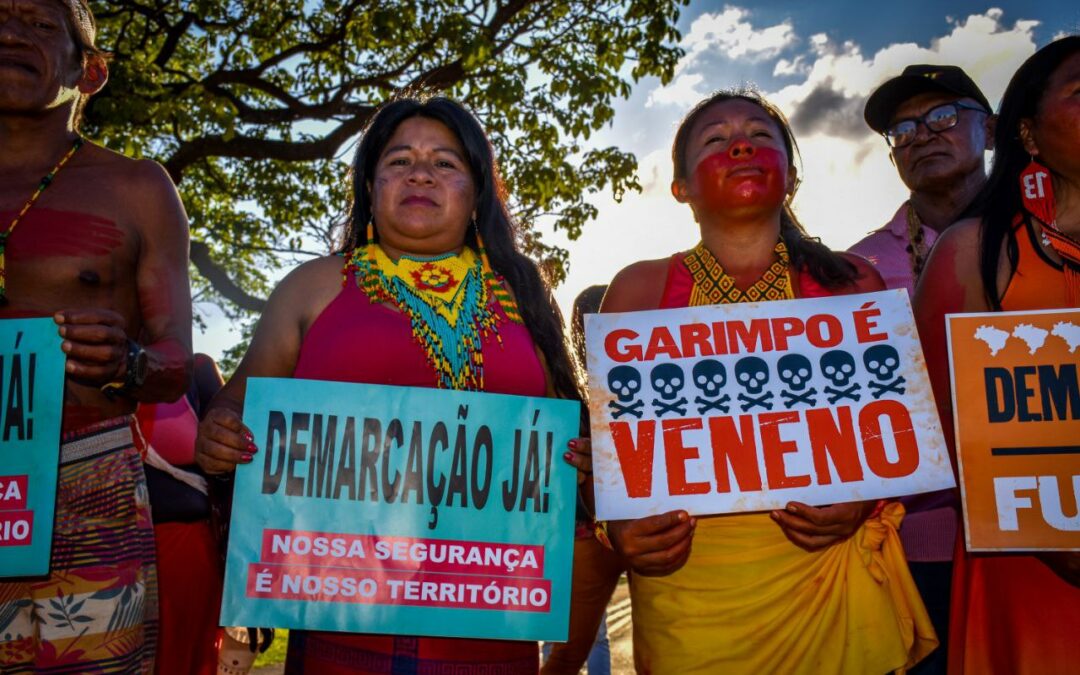
Photo: @joseruigaviao / Ya Gavião
April is considered a month of national mobilization, resistance, and visibility for Indigenous peoples in Brazil. Indigenous April begins with the Free Land Camp (Acampamento Terra Livre – ATL), held in Brasília (DF). ATL 2026 will take place from April 5 to 11 at the Eixo Cultural Ibero-Americano (formerly Funarte), under the theme “Our future is not for sale: we are the answer”. The mobilization is an initiative of the Articulation of Indigenous Peoples of Brazil (APIB).
In its 22nd edition, the program highlights threats to Indigenous territories and Indigenous peoples, while also presenting responses to the climate crisis and the strengthening of democracy. The mobilization is structured around five axes: We Are the Answer; Our Future Is Not for Sale; Our Struggle for Life!; Demarcated Land, Sovereign Brazil and Guaranteed Democracy; and Tell the People to Move Forward!
On April 6, Indigenous leaders from all regions of the country will discuss the violence experienced during the military dictatorship in the plenary session “Memory, Truth and Justice for Indigenous Peoples.” The panel is organized by the Forum on Memory, Truth, Full Reparation, Non-Repetition and Justice for Indigenous Peoples, an initiative aimed at expanding public debate on transitional justice for Indigenous peoples and, above all, at formulating a proposal for the creation of a National Indigenous Truth Commission (CNIV).
On April 7, the program will feature the march “Congress, enemy of the peoples: our future is not for sale.” In 2026, at least six anti-Indigenous proposals are under consideration in the National Congress, such as Constitutional Amendment Proposal (PEC) 48 (Timeframe Thesis – Marco Temporal); Legislative Decrees (PDLs) against land demarcations (717/2024, 1121/2025, 1126/2025 and 1153/2025); the Working Group on Mining in Indigenous Lands; Bill of Law 6050/2023 (Economic Exploitation); and Bill of Law 6093/2023 (Agribusiness Bill).
On April 8, the Indigenous movement will strengthen its engagement in international spaces as part of a political strategy of resistance and articulation, during the plenary session “From traditional territory to the global stage: the Brazilian Indigenous movement in the socio-environmental struggle.” In addition to the panel, APIB will also promote a meeting between Indigenous leaders and embassies, as well as a gathering of Indigenous communicators from Guatemala and Brazil.
On April 9, the 2026 elections will also be part of the discussions at the Free Land Camp, in the panel ‘Indigenous Campaign: we are the answer to transforming politics.’ The plenary will take place that same day and is named after the manifesto published by the Articulation of Indigenous Peoples of Brazil (APIB) last year, which reaffirms the commitment to continue the Indigenous Campaign and the project of ‘indigenizing’ politics. ‘There is no climate agenda without Indigenous political leadership,’ the document states.
April 9 will also feature the march “Demarcate, Lula: a sovereign Brazil is one with demarcated and protected Indigenous lands.” According to APIB, around 76 Indigenous Lands are ready to be ratified and are only awaiting President Lula’s signature as of March this year. Another 34, still depend on the Minister of Justice for the issuance of the declaratory ordinance.
On April 10, the camp’s program will conclude with a plenary session and the reading of the final document. April 5 and 11 will be reserved for the arrival and departure of delegations to and from their territories. Access the full program here: https://apiboficial.org/atl-2026/.
The Articulation of Indigenous Peoples of Brazil (APIB) has launched a fundraising campaign for the camp. To contribute, simply visit www.apiboficial.org/apoie/. Donations can be made by credit card or bank slip (boleto). It is also possible to donate via Pix using the email [email protected] (Articulation of Indigenous Peoples and Organizations of the Northeast, Minas Gerais and Espírito Santo – Bradesco Bank).
About ATL
For 22 years, ATL has brought together thousands of Indigenous leaders from the five regions of the country in the federal capital to denounce rights violations, influence public authorities, and defend their territories.
In 2025, ATL gathered more than 9,000 Indigenous participants in Brasília. With the theme “APIB is all of us: in defense of the Constitution and life,” the mobilization celebrated 20 years of struggle and achievements of the Articulation of Indigenous Peoples of Brazil.
In its final letter, the camp reaffirmed the defense of territorial rights and Indigenous leadership in the global climate agenda. “Our science and ancestral systems, expressed through agroecology, Indigenous economies, collective territorial management, and our spiritual relationship with Mother Nature, preserve biodiversity, all forms of life, including water sources, and sustain healthy and balanced food systems. Therefore, we demand the immediate resumption of the demarcation of all Indigenous lands in Brazil as an effective climate policy, as well as direct funding for the full protection of our territories and ways of life.”
About APIB
The Articulation of Indigenous Peoples of Brazil (APIB) is a national reference body of the Indigenous movement, built from the grassroots. It brings together seven regional Indigenous organizations (Apoinme, ArpinSudeste, ArpinSul, Aty Guasu, Conselho Terena, Coiab, and Comissão Guarani Yvyrupa). It was established to strengthen the unity of Indigenous peoples, coordinate across different regions and organizations, and mobilize against threats and violations of Indigenous rights.
For more information and to schedule interviews, contact:
Email: [email protected]
Phone numbers:
Samela Sateré Mawé, APIB Communications Coordinator: (92) 98285-5077
Yago Kaingang/Fulni-ô, APIB Communications Coordinator: (43) 98868-5501
Ariel Bentes, journalist in the APIB communications and press team: (92) 99430-3762
01/Dec/2025
APIB’s assessment highlights historical achievements, but demands territorial ambition and binding mechanisms for the climate future.
The 30th UN Climate Change Conference (COP30), held in Belém between November 10 and 22, marked an unprecedented moment by placing the territories, voices, and proposals of Indigenous Peoples at the center of the global climate debate. The Indigenous movement arrived with a clear agenda, synthesized in the Indigenous NDC’s, the result of years of multilateral articulation with governments, philanthropy, funds, among other actors. According to APIB and its seven regional organizations, the achievements result from struggle and political articulation, not from voluntary concessions.
“In this COP, there were great advances on the Indigenous agenda, specifically in territorial recognition and demarcations as a mitigation policy. This is a demand of Indigenous Peoples that guided the Federal Government through the NDCs. It is important to emphasize that these advances were not delivered or given, but rather the result of struggle, construction, and dialogue for these manifestations to occur,” said Dinamam Tuxá, APIB executive coordinator for APOINME.
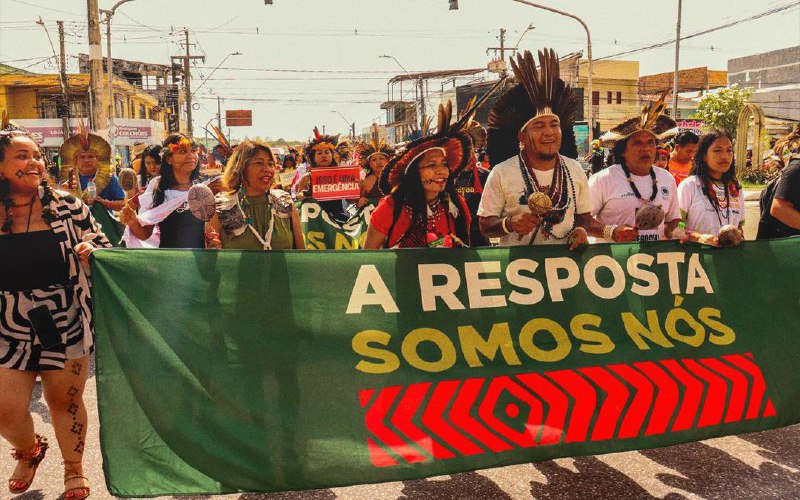
APIB recorded the largest Indigenous participation in the history of the COPs: around 5,000 Indigenous people present in Belém, more than 4,000 Brazilians, and more than 900 accredited in the Blue Zone, surpassing Dubai. The marches were central, especially the Global Indigenous March – The Answer is Us, which brought together more than 3,000 people demanding demarcation and territorial protection.
“There was a significant advance in participation in the Blue Zone, with Indigenous delegations engaged in important debates about the climate crisis. We know that it is still not the ideal number of participation we desire for Indigenous Peoples, but it already represents progress,” said Alberto Terena, APIB executive coordinator for the Terena Council.
The main demand — the recognition of the demarcation and protection of Indigenous territories as climate policy — saw advances with 10 declaratory ordinances, four homologations (official approvals), and six finalized studies. However, the pace remains insufficient: 93 Indigenous Lands are ready for demarcation and awaiting completion.
“This COP 30 had the largest participation of Indigenous Peoples, and although we had some advances in demarcations, we would like them to be broader, especially in territories with a greater number of violent acts,” said Luana Kaingang, Arpinsul coordinator.
Among the institutional advances, the announcement of the Indigenous Land Protection Program (PPTI) stands out, structured on three pillars: demarcation and legal certainty; territorial management led by Indigenous people; and strengthening of organizations with their own financial mechanisms. APIB advocates for co-decisional governance in the program.
Other achievements were: the inclusion of Indigenous Peoples, Local Communities, and Afro-descendant Peoples in the final text; the recognition of the Protection of Indigenous Peoples in Voluntary Isolation and Initial Contact in the Just Transition Work Programme; the presentation of the Indigenous NDC as the only non-state proposal; and international awards received by APIB during COP30.
In the financial sphere, there were concrete announcements. During COP30, the Funders Group on Forests and Tenure (FTFG) announced its second global commitment to support the territorial rights of Indigenous Peoples, local communities, and Afro-descendants — recognizing their central role in protecting forests, biodiversity, and combating the climate crisis. The new commitment foresees an investment of US$1.8 billion between 2026 and 2030.
APIB, through the Global Alliance of Territorial Communities (GATC) and its Shandia Platform, worked for this announcement to materialize and to ensure that resources were not restricted to forest ecosystems but included all biomes, recognizing the Indigenous presence throughout the territory.
Furthermore, more than US$6.6 billion was announced for the Tropical Forest Forever Fund (TFFF), which stipulated that 20% of the payments destined for each country will be directed directly to Indigenous and local community organizations. APIB decided to actively engage in the TFFF co-design process in February 2025, understanding that the initiative represents a concrete opportunity to transform the architecture of climate finance.
Challenges for COP31
Despite the progress, the final COP30 agreement fell short of what is necessary. There was no inclusion of a Roadmap for phasing out fossil fuels and no progress towards zero deforestation by 2030. APIB denounces that the recognition of the importance of Indigenous Peoples was not accompanied by binding mechanisms:
-
Territorial rights need to appear in the operational part of the text, and not just in introductory paragraphs.
-
Free, Prior, and Informed Consent (FPIC) needs to become an operational obligation in climate mechanisms, ensuring binding consent, and not just symbolic consultations.
-
Exclusion Zones free of mining and destructive extractivism in the territories of Indigenous Peoples in Isolation or Initial Contact (PIIRC) were not guaranteed.
-
Law 14.701 (Temporal Framework) continues to limit the effectiveness of demarcations and impose legal uncertainty.
Towards COP31, APIB will continue with the campaign “The Answer is Us,” demanding the implementation of the Indigenous NDC, consolidation of the PPTI, defense of the end of fossils, and guarantee of democratic spaces for social pressure. For APIB, there will be no real climate ambition without territorial ambition.
Access APIB’s report on COP30 here: https://apiboficial.org/2025/11/27/avaliacao-da-articulacao-dos-povos-indigenas-do-brasil-apib-sobre-a-cop30/?lang=en
10/Nov/2025
APIB mobilizes over 3,000 indigenous people and proposes goals in conference negotiations
Leaders of the Articulation of Indigenous Peoples of Brazil (APIB) and its regional organizations are participating, starting today, November 10, in the United Nations (UN) Climate Change Conference of the Parties, COP-30, in Belém, Pará. APIB, a national reference for the indigenous movement in the country, demands that the demarcation and protection of Indigenous Lands be the legacy left by the conference in Brazil.
“Our peoples, territories, and traditional ways of life are part of the solution to combat the climate crisis, but unfortunately, the Conference of the Parties does not officially consider indigenous peoples as negotiators. That is why we have been pressing them for months so that the demarcation of Indigenous Lands is at the center of the agenda. We will also mobilize in the streets and show that change needs to happen now,” affirms Dinamam Tuxá, executive coordinator of APIB.
Brazil currently has 107 Indigenous Lands (TIs) ready to be demarcated and awaiting the finalization of the process: 37 are waiting for the declaration ordinance and 70 for the homologation ordinance. Most of the TIs awaiting homologation, the last stage of the process, are concentrated in Mato Grosso do Sul and São Paulo (10), followed by Amazonas (9) and Pará (8). The data is part of a survey by the Articulation of Indigenous Peoples of Brazil (Apib). But the demand for demarcation is even greater: another 161 TIs are in earlier stages of the demarcation process, revealing the dimension of the challenge faced by the indigenous movement in the fight for the guarantee of their recognized and protected territories.
Advancements
Kleber Karipuna, executive coordinator of APIB, comments that the articulations for COP30 began two years ago and resulted in announcements of commitments even before the official start of the COP, such as the one announced by the Forest and Climate Leaders’ Partnership (FCLP), which ensures the unprecedented commitment to a global goal of recognizing indigenous and local community territories, including demarcation goals for the next five years.
Furthermore, we had the guarantee of at least 20% of the Tropical Forests Forever Fund (TFFF) resources destined for direct access by indigenous peoples and local communities, and the Forest Tenure Funders Group (FTFG) announced on November 6 a new financial commitment of US$1.8 billion for actions related to strengthening the land tenure rights of Indigenous Peoples and Local Communities (IP&LCs).
“The articulation of the indigenous movement, not only Brazilian but globally, has been intense over the last two years. The goal was to arrive at COP30 with concrete proposals. In partnership with the Global Alliance of Territorial Communities, the work to ensure a commitment to territorial recognition was also crucial. This commitment was developed jointly with the FCLP, aiming for countries and combined forces worldwide to recognize the territories of indigenous peoples, local communities, traditional peoples, quilombolas, and conservation areas. The recognition of these lands is fundamental for achieving global climate goals,” says Kleber Karipuna, executive coordinator of APIB.
Program
For COP30, the Articulation divided its strategies into five axes: strengthening the “We Are the Response” Campaign, political articulation with the Peoples’ Summit and the Global Alliance of Territorial Communities, advocacy in the COP30 negotiations through the elaboration of the Indigenous Nationally Determined Contribution (NDC), action agendas, and the promotion of indigenous governance and participation in COP-30.
In total, more than 3,000 indigenous people are expected to participate in COP30, which runs until November 21. The COP is divided into two official spaces: the blue zone and the green zone. This year, APIB’s delegation has about 360 people credentialed for the blue zone, the restricted space of the conference focused on climate negotiations. However, APIB leaders will also join forces in the Green Zone, at Aldeia COP, at the Peoples’ Summit, and in events in various civil society spaces in the city of Belém.
Among the highlights of the program is the opening of the Indigenous COP at Aldeia COP, located at the Application School of the Federal University of Pará (UFPA), on November 12. The space is organized by the Ministry of Indigenous Peoples (MPI) and supported by the indigenous movement.
The indigenous movement’s agenda also includes two marches: the Global Peoples’ March, organized by the Peoples’ Summit, will be held on November 15, and the Global Indigenous March – We Are the Response on the 17th.
To learn more details about the program and APIB’s strategies for COP30, visit the organization’s website: https://apiboficial.org/cop-30/.
23/Sep/2025
Photo: @owapichana/ APIB
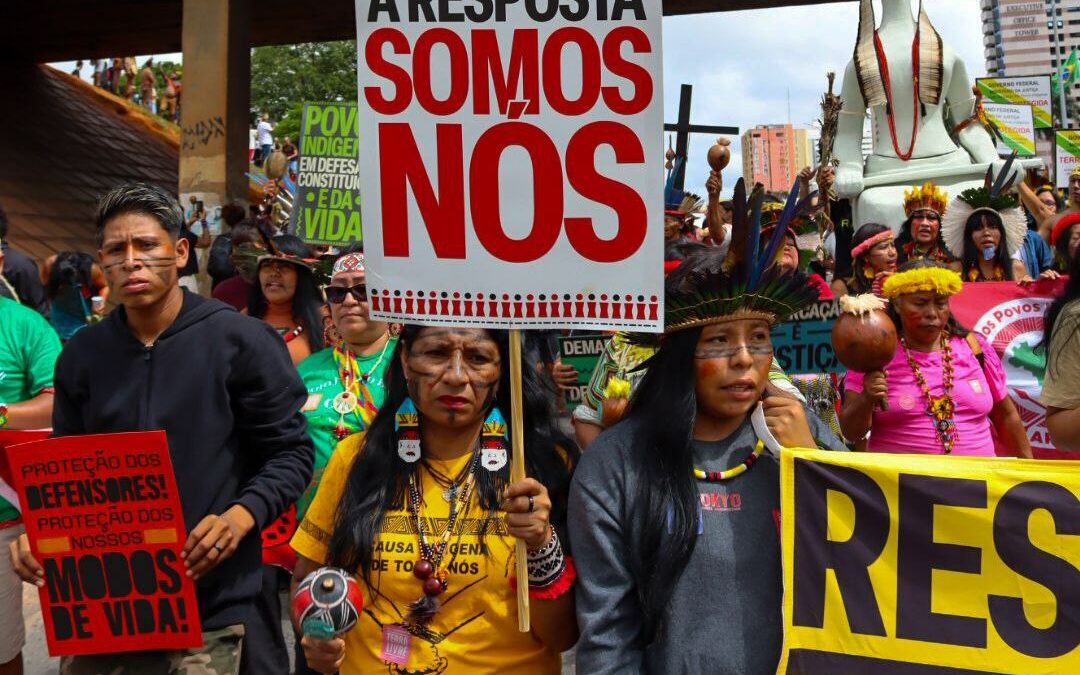
The official site of the “The Answer Is Us” campaign is now available.
The campaign “The Answer Is Us” echoes voices from different territories — peoples of the forests, the waters, the countryside and the cities — in an urgent global mobilization for climate and life, leading up to COP30, which will be held in November, in Belém (PA). All information can be accessed at theanswerisus.org
The members of the campaign reinforce that science confirms what ancestral knowledge always flagged: there is no climate justice without territorial, social and popular justice.
The campaign was created by the Indigenous Peoples of the Amazon and Brazil, launched by the COIAB (Coordenação das Organizações Indígenas da Amazônia Brasileira) in June 2024. It was then joined by APIB (the Articulation of Indigenous Peoples of Brazil), the Amazon G9 and the Global Alliance of Territorial Communities, gaining strength at national and international level. Now, it also includes social and activist movements from different parts of the world.
Campaign demands:
- Land Rights = Climate action: proteger territórios é proteger toda a vida no planeta. Sem reforma agrária, demarcação, titulação, regularização fundiária e proteção integral, não haverá ecossistemas capazes de conter o colapso climático.
- Desmatamento zero: frear a destruição que gera grandes emissões de carbono e devasta os ecossistemas reguladores do clima global é uma urgência.
- Não aos combustíveis fósseis e à mineração: petróleo, gás e carvão são os principais causadores da crise global, e essa indústria bilionária precisa ser desmontada. A campanha também rejeita projetos de transição energética que violem territórios, exigindo uma transição justa, soberana e que priorize a vida sobre o lucro.
- Proteção dos defensores e modos de vida: é necessária proteção imediata e integral para quem defende a terra, as águas, as florestas e o clima. Não haverá política climática justa enquanto persistir a impunidade e violência.
- Acesso direto ao financiamento climático: os recursos para enfrentar a crise devem chegar diretamente a quem está na linha de frente — povos da floresta, das águas, do campo e das cidades. A campanha exige repasses sem burocracia colonial ou intermediários.
- Participation with real power: COP30 will be held in the Amazon. We demand a dignified, permanent presence with real power in decision-making. We will not accept playing the part of extras in a stage that decides the fate of the climate—and our lives—far away from us. Climate justice is built with real participation, not behind closed doors.
Call for global mobilizations
APIB calls on organizations and individuals to mobilize in communities, streets, squares, and centers of power. The next mobilization of the “We Are the Answer” campaign will be on October 13th.
Partner organizations are encouraged to hold demonstrations in their territories and use the mobilization materials available in Portuguese, English, Spanish, French, and Bahasa on the campaign website—posters, banners, and t-shirts are already ready for use.