26/Aug/2026
During the 17th Conference of the Parties to the United Nations Convention to Combat Desertification (COP17), held in Mongolia, APIB, together with APOINME (our grassroots political organization), hosted the panel “Indigenous perspectives on desertification: pathways to address land degradation and prolonged drought in Brazilian biomes”.
The event presented Indigenous perspectives on the spread of desertification and land degradation, as well as the effects of prolonged droughts on Brazilian biomes. The discussion focused particularly on the impacts on Indigenous territories, which face increasing pressure from deforestation, land grabbing, mining, the expansion of commodity supply chains, and the exploitation of water and other natural resources.
The panel was moderated by Danilo Tupinikim (APIB) and featured Bárbara Tupinikim, representing the Articulation of Indigenous Peoples and Organizations of the Northeast, Minas Gerais, and Espírito Santo (APOINME); Rute Anacé, from the Ministry of Indigenous Peoples (MPI); and Onel Inanadinia Masardule, a consultant for the International Indian Treaty Council.
Throughout the dialogue, participants emphasized that addressing desertification cannot be limited to technical or environmental solutions. For Indigenous peoples, this is also an agenda concerning rights, climate justice, territorial protection, and historical reparation.
Territorial degradation directly affects water sources, food production, biodiversity, and the continuity of traditional ways of life, knowledge, and practices. These impacts are exacerbated by economic activities that encroach upon biomes without respecting the territorial rights, cultures, and autonomy of Indigenous peoples. Among the pathways presented during the panel are the demarcation and effective protection of Indigenous lands, the strengthening of Indigenous territorial and environmental management, the provision of direct funding to Indigenous peoples, and the guarantee of consultation and free, prior, and informed consent regarding measures and projects that could affect their territories.
The panel also highlighted the need for traceability across all stages of commodity supply chains and the accountability of companies and economic activities involved in biome degradation and the violation of Indigenous rights.
The event brought together representatives from governments, Indigenous organizations, and civil society, as well as negotiators, researchers, funders, and international bodies involved in developing responses to desertification, drought, and land degradation.
By bringing these perspectives to COP17, the panelists shared the voices of Indigenous peoples, reaffirming that we should not be recognized merely as populations affected by the environmental crisis. Traditional knowledge, management practices, and distinct forms of territorial governance are essential for protecting water resources, restoring ecosystems, and building just, lasting responses to the climate crisis.
Strengthening the rights and leadership of Indigenous peoples is indispensable to tackling desertification and securing the world’s future.
17/Aug/2026
The Articulation of Indigenous Peoples of Brazil (APIB) will participate in the 17th Session of the Conference of the Parties to the United Nations Convention to Combat Desertification (COP17), to be held from August 17 to 28, 2026, in Ulaanbaatar, Mongolia. The organization will bring the perspectives, demands and proposals of Indigenous Peoples in Brazil to the international debate on addressing desertification, land degradation and drought.
APIB’s participation is grounded in the recognition that Indigenous Peoples are among those most directly affected by environmental degradation processes and the effects of prolonged droughts. Across different Brazilian biomes, Indigenous territories are affected by deforestation, land grabbing, mining, the expansion of commodity production chains, and pressure on water resources and traditional ways of life.
These processes threaten not only ecosystems, but also water sources, food sovereignty, biodiversity, traditional knowledge, cultural practices and the very continuity of Indigenous Peoples’ ways of life.
For APIB, addressing desertification cannot be treated solely as a technical or environmental agenda. It is also an agenda of Indigenous rights, climate justice, territorial protection and historical reparation.
In this regard, the demarcation and protection of Indigenous territories, the strengthening of Indigenous territorial and environmental management, direct financing for Indigenous Peoples, the guarantee of free, prior and informed consultation and consent (FPIC), traceability throughout commodity production chains, and accountability for economic activities that degrade biomes are key measures to address land degradation, drought and the impacts of the climate crisis.
Side Event at the Brazil Pavilion
During COP17, APIB, in partnership with its indigenous regional organization, the Articulation of Indigenous Peoples and Organizations of the Northeast, Minas Gerais and Espírito Santo (APOINME), will hold a side event at the Brazil Pavilion, located at C2 in the Blue Zone.
The event will take place on August 19, from 5:00 to 6:00 p.m. (local time), under the title:
Indigenous Perspectives on Desertification: Pathways to Address Land Degradation and Prolonged Drought in Brazil’s Biomes.
The panel will bring together Indigenous leaders from Brazil to discuss the advance of desertification and the effects of drought across Brazilian biomes from the perspectives of Indigenous Peoples, with particular attention to impacts on Indigenous territories and traditional ways of life.
The event will seek to affirm that combating desertification requires responses that go beyond exclusively technical or environmental approaches. The protection of territories, the guarantee of Indigenous rights, and the strengthening of Indigenous forms of territorial and environmental management are fundamental elements for addressing biome degradation and building effective responses to the climate crisis.
The panel will also address measures such as direct financing for Indigenous Peoples, the guarantee of free, prior and informed consultation and consent (FPIC), traceability throughout commodity production chains, and accountability for economic activities that contribute to environmental degradation.
The event will be aimed at government representatives, negotiators, civil society organizations, academics, funders, international organizations and other stakeholders involved in developing responses to desertification, drought and land degradation.
APIB’s participation in COP17 reaffirms that there can be no effective action against desertification without Indigenous rights, nor climate justice without the protection of Indigenous territories.
10/Nov/2025
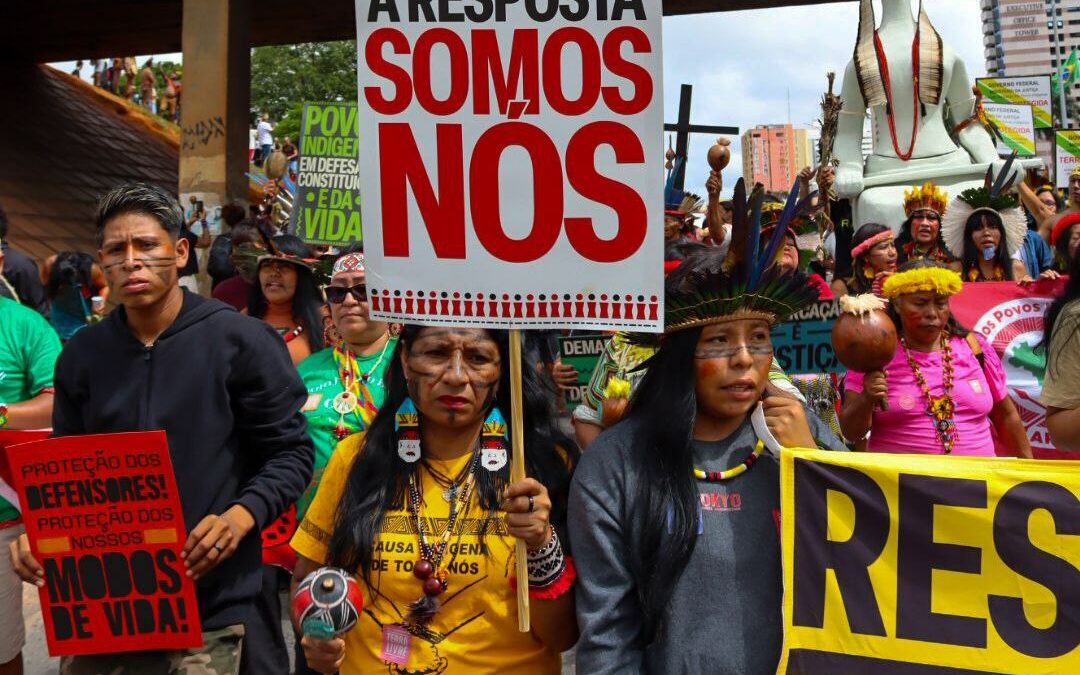
APIB mobilizes over 3,000 indigenous people and proposes goals in conference negotiations
Leaders of the Articulation of Indigenous Peoples of Brazil (APIB) and its regional organizations are participating, starting today, November 10, in the United Nations (UN) Climate Change Conference of the Parties, COP-30, in Belém, Pará. APIB, a national reference for the indigenous movement in the country, demands that the demarcation and protection of Indigenous Lands be the legacy left by the conference in Brazil.
“Our peoples, territories, and traditional ways of life are part of the solution to combat the climate crisis, but unfortunately, the Conference of the Parties does not officially consider indigenous peoples as negotiators. That is why we have been pressing them for months so that the demarcation of Indigenous Lands is at the center of the agenda. We will also mobilize in the streets and show that change needs to happen now,” affirms Dinamam Tuxá, executive coordinator of APIB.
Brazil currently has 107 Indigenous Lands (TIs) ready to be demarcated and awaiting the finalization of the process: 37 are waiting for the declaration ordinance and 70 for the homologation ordinance. Most of the TIs awaiting homologation, the last stage of the process, are concentrated in Mato Grosso do Sul and São Paulo (10), followed by Amazonas (9) and Pará (8). The data is part of a survey by the Articulation of Indigenous Peoples of Brazil (Apib). But the demand for demarcation is even greater: another 161 TIs are in earlier stages of the demarcation process, revealing the dimension of the challenge faced by the indigenous movement in the fight for the guarantee of their recognized and protected territories.
Advancements
Kleber Karipuna, executive coordinator of APIB, comments that the articulations for COP30 began two years ago and resulted in announcements of commitments even before the official start of the COP, such as the one announced by the Forest and Climate Leaders’ Partnership (FCLP), which ensures the unprecedented commitment to a global goal of recognizing indigenous and local community territories, including demarcation goals for the next five years.
Furthermore, we had the guarantee of at least 20% of the Tropical Forests Forever Fund (TFFF) resources destined for direct access by indigenous peoples and local communities, and the Forest Tenure Funders Group (FTFG) announced on November 6 a new financial commitment of US$1.8 billion for actions related to strengthening the land tenure rights of Indigenous Peoples and Local Communities (IP&LCs).
“The articulation of the indigenous movement, not only Brazilian but globally, has been intense over the last two years. The goal was to arrive at COP30 with concrete proposals. In partnership with the Global Alliance of Territorial Communities, the work to ensure a commitment to territorial recognition was also crucial. This commitment was developed jointly with the FCLP, aiming for countries and combined forces worldwide to recognize the territories of indigenous peoples, local communities, traditional peoples, quilombolas, and conservation areas. The recognition of these lands is fundamental for achieving global climate goals,” says Kleber Karipuna, executive coordinator of APIB.
Program
For COP30, the Articulation divided its strategies into five axes: strengthening the “We Are the Response” Campaign, political articulation with the Peoples’ Summit and the Global Alliance of Territorial Communities, advocacy in the COP30 negotiations through the elaboration of the Indigenous Nationally Determined Contribution (NDC), action agendas, and the promotion of indigenous governance and participation in COP-30.
In total, more than 3,000 indigenous people are expected to participate in COP30, which runs until November 21. The COP is divided into two official spaces: the blue zone and the green zone. This year, APIB’s delegation has about 360 people credentialed for the blue zone, the restricted space of the conference focused on climate negotiations. However, APIB leaders will also join forces in the Green Zone, at Aldeia COP, at the Peoples’ Summit, and in events in various civil society spaces in the city of Belém.
Among the highlights of the program is the opening of the Indigenous COP at Aldeia COP, located at the Application School of the Federal University of Pará (UFPA), on November 12. The space is organized by the Ministry of Indigenous Peoples (MPI) and supported by the indigenous movement.
The indigenous movement’s agenda also includes two marches: the Global Peoples’ March, organized by the Peoples’ Summit, will be held on November 15, and the Global Indigenous March – We Are the Response on the 17th.
To learn more details about the program and APIB’s strategies for COP30, visit the organization’s website: https://apiboficial.org/cop-30/.
23/Sep/2025
Photo: @owapichana/ APIB
The official site of the “The Answer Is Us” campaign is now available.
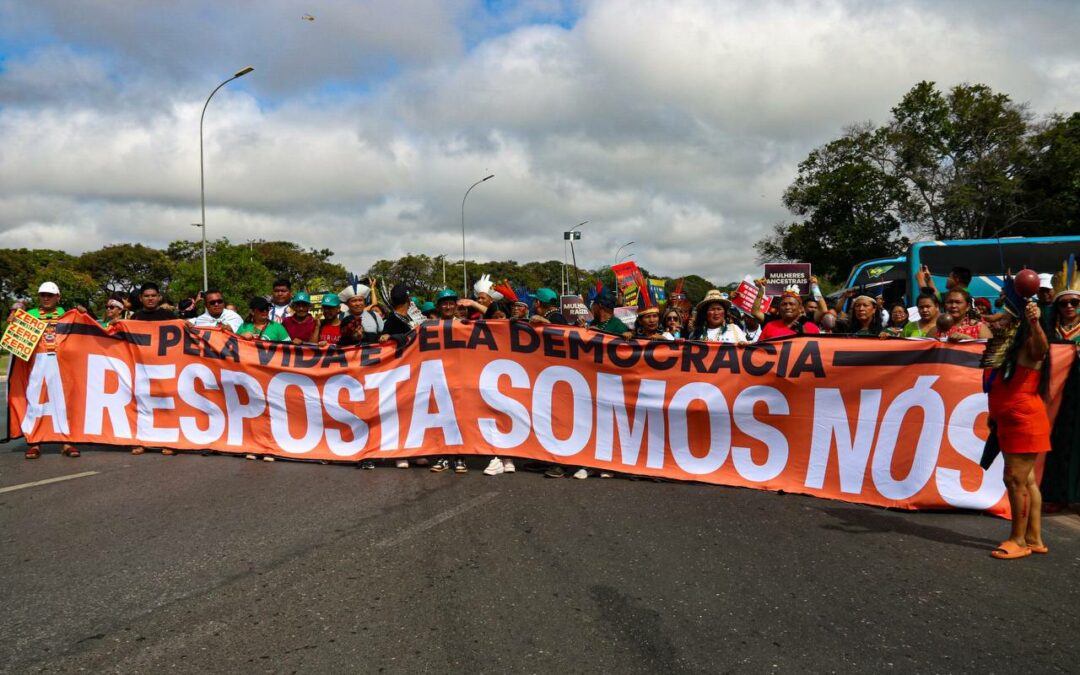
The campaign “The Answer Is Us” echoes voices from different territories — peoples of the forests, the waters, the countryside and the cities — in an urgent global mobilization for climate and life, leading up to COP30, which will be held in November, in Belém (PA). All information can be accessed at theanswerisus.org
The members of the campaign reinforce that science confirms what ancestral knowledge always flagged: there is no climate justice without territorial, social and popular justice.
The campaign was created by the Indigenous Peoples of the Amazon and Brazil, launched by the COIAB (Coordenação das Organizações Indígenas da Amazônia Brasileira) in June 2024. It was then joined by APIB (the Articulation of Indigenous Peoples of Brazil), the Amazon G9 and the Global Alliance of Territorial Communities, gaining strength at national and international level. Now, it also includes social and activist movements from different parts of the world.
Campaign demands:
- Land Rights = Climate action: proteger territórios é proteger toda a vida no planeta. Sem reforma agrária, demarcação, titulação, regularização fundiária e proteção integral, não haverá ecossistemas capazes de conter o colapso climático.
- Desmatamento zero: frear a destruição que gera grandes emissões de carbono e devasta os ecossistemas reguladores do clima global é uma urgência.
- Não aos combustíveis fósseis e à mineração: petróleo, gás e carvão são os principais causadores da crise global, e essa indústria bilionária precisa ser desmontada. A campanha também rejeita projetos de transição energética que violem territórios, exigindo uma transição justa, soberana e que priorize a vida sobre o lucro.
- Proteção dos defensores e modos de vida: é necessária proteção imediata e integral para quem defende a terra, as águas, as florestas e o clima. Não haverá política climática justa enquanto persistir a impunidade e violência.
- Acesso direto ao financiamento climático: os recursos para enfrentar a crise devem chegar diretamente a quem está na linha de frente — povos da floresta, das águas, do campo e das cidades. A campanha exige repasses sem burocracia colonial ou intermediários.
- Participation with real power: COP30 will be held in the Amazon. We demand a dignified, permanent presence with real power in decision-making. We will not accept playing the part of extras in a stage that decides the fate of the climate—and our lives—far away from us. Climate justice is built with real participation, not behind closed doors.
Call for global mobilizations
APIB calls on organizations and individuals to mobilize in communities, streets, squares, and centers of power. The next mobilization of the “We Are the Answer” campaign will be on October 13th.
Partner organizations are encouraged to hold demonstrations in their territories and use the mobilization materials available in Portuguese, English, Spanish, French, and Bahasa on the campaign website—posters, banners, and t-shirts are already ready for use.
10/Apr/2025
Photo: _ @sallynhandewa
With the launch of an Indigenous NDC and the creation of an international commission, APIB strengthens the participation of Indigenous Peoples on the road to COP-30 in Belém.
The Articulation of Indigenous Peoples of Brazil (APIB) will launch today (April 10), at the Free Land Camp (ATL), an Indigenous Nationally Determined Contribution (NDC). In addition, the Ministry of Indigenous Peoples will announce an Indigenous International Commission for the United Nations Climate Change Conference (COP-30), which will take place in November in the city of Belém (Pará).
The NDC and the commission will be announced at the plenary “We Are the Answer: Indigenous Peoples on the Road to COP-30,” at the ATL, starting at 2 p.m., with the presence of Ambassador André Corrêa do Lago, president of COP-30. Ministers Sonia Guajajara, from the Ministry of Indigenous Peoples (MPI), and Marina Silva, from the Ministry of Environment and Climate Change (MMA), along with Federal Deputy Célia Xakriabá, who will also join the panel. These actions are part of the global campaign “We Are the Answer,” led by the Indigenous movement, which asserts that Indigenous Peoples and the demarcation of Indigenous Territories are essential in the fight against the climate crisis.
Developed from the accumulation of proposals by APIB’s regional organizations, the Indigenous NDC reinforces that the climate debate must consider equity, self-determination, and the effective participation of Indigenous Peoples and traditional communities in the implementation of Brazil’s NDC under the Paris Agreement.
The document is divided into six thematic axes:
- Mitigation, which defends the recognition and protection of territorial rights as essential climate mitigation policy;
- Adaptation, which highlights the importance of protecting ancestral knowledge, such as fire management and indigenous medicine;
- Financing, which proposes revising existing mechanisms and creating specific tools for the direct funding of indigenous organizations;
- Technology transfer, which suggests integrating traditional knowledge with modern science in climate strategies;
- Capacity-building, focused on technical training and access to climate information in accessible language;
- Justice and ambition, which recognizes the historical debt owed to indigenous and traditional peoples;
- Co-benefits, which links land demarcation to climate action, strengthening Brazil’s international commitments.
“The document is based on climate justice, the right to free, prior and informed consent, and the importance of solutions that respect nature and are conceived and led by Indigenous Peoples,” says Dinamam Tuxá, executive coordinator of APIB.
Commission for the Conference of the Parties
With the mission of amplifying the visibility and influence of Indigenous Peoples in climate negotiations, the Indigenous International Commission for COP-30 will be chaired by Minister Sonia Guajajara and will include the following organizations: APIB, COIAB, ANMIGA, the G9 of the Amazon, the Global Alliance of Territorial Communities (GATC), and the United Nations Permanent Forum on Indigenous Issues (UNPFII). There is also dialogue to include other international Indigenous organizations and forums.
“The commission is a platform that seeks to advance Indigenous rights, resilience, and climate leadership. At COP-30, we have the opportunity to ensure the best and largest indigenous participation in history. Our goal is to have one thousand accredited Indigenous representatives in the Blue Zone,” says Minister Guajajara.
The commission’s responsibilities include developing a methodology to guarantee Indigenous Peoples’ accreditation for the Conference of the Parties as an institutionalized practice for future COPs; ensuring focus on the specific priorities of Indigenous Peoples; conducting regional meetings; and planning and implementing high-level events and meetings with state parties, UN agencies, and allies to amplify indigenous demands.
International Participation at ATL 2025
The 21st edition of the Free Land Camp is marked by the participation of international indigenous delegations. Indigenous representatives from more than 15 countries are participating, including from the eight Amazon Basin countries, Australia, and Fiji, as well as leaders from the Global Alliance of Territorial Communities (GATC), which represents Indigenous Peoples and local communities from 24 countries.
According to APIB, the organizations participating in the mobilization include: Interethnic Association for the Development of the Peruvian Rainforest (AIDESEP), Amerindian Peoples Association (APA – Guyana), Confederation of Indigenous Nationalities of the Ecuadorian Amazon (CONFENIAE), Confederation of Indigenous Peoples of Bolivia (CIDOB), Federation of Indigenous Organizations of French Guiana (FOAG), Organization of Indigenous Peoples of Suriname (OIS), National Organization of Indigenous Peoples of the Colombian Amazon (OPIAC), Regional Organization of Indigenous Peoples of the Amazon (ORPIA), and the Global Alliance of Territorial Communities.
On April 10, the delegations will participate in the “Meeting with Embassies: We Are the Answer – Indigenous Peoples’ Visions for COP-30,” with the aim of bringing Indigenous demands to the embassies of Germany, Austria, Australia, Canada, Denmark, Spain, France, Finland, Ireland, Norway, the Netherlands, Peru, the United Kingdom, Sweden, Switzerland, and the European Union. Also participating will be the Ministry of Indigenous Peoples, Ministry of Environment and Climate Change, Ministry of Foreign Affairs, and the German Agency for International Cooperation (GIZ).
ATL 2025 brings together over 7,000 Indigenous participants at the National Arts Foundation (Funarte) in Brasília. Under the motto “We Are the Answer,” on April 10 at 4 p.m., Indigenous Peoples will march through the streets of the federal capital to the Plaza of the Three Powers.
02/May/2024
Indigenous land titling in Brazil has fallen behind as president Lula had promised to complete 14 processes in his first 100 days of government, but had only titled 10 in over a year in power.
April, 2024.- President Luiz Inácio Lula da Silva met with a delegation of 40 indigenous leaders from across Brazil last Thursday (25) afternoon at the Palácio do Planalto. The gathering, which took place during the 20th edition of the Free Land Camp (Acampamento Terra Livre ATL)- the largest indigenous mobilisation in the country- concluded with the creation of a Task Force to advance land titling.
The meeting followed a massive march where eight thousands of Indigenous Peoples and Civil Society Movements filled the city’s central area with echoing chants and energetic calls for the government to advance land titling and stop large projects that pose threats to their territories. The rally ended at the Praça dos Três Poderes, where groups of indigenous organisations continued on with their protest as the meeting took place.
The Articulation of Indigenous Peoples of Brazil (APIB) had been denouncing the government’s failed promise to title 14 indigenous lands in the first 100 days of Lula’s government. In over a year they had titled 10 of those lands, whilst many others awaited. Moreover, they raised alarms as Congress debated passing a law that could severely limit their rights to land, the Time Frame Law (Marco Temporal).
“In our understanding, there is no legal impediment to land titling. What there is is a political impediment, which we hope will be resolved with this task force, which is a demand from the indigenous movement, so that we can actually unblock land demarcations. Not only of the four lands, not only of the 25 lands with declaratory ordinances [already signed], but so that, once and for all, we can overcome administrative and political issues for demarcating indigenous lands in the country,” said Dinamam Tuxá, a Executive Coordinator to APIB.
Responding to the primary demands of APIB, the government announced the establishment of a governmental task force aimed at unlocking pending land titling processes awaiting presidential approval. Priority will be given to four key areas–including the Xukuru e Morro dos Cavalos- each mired in disputes awaiting resolution.
The task force, chaired by Minister Guajajara, will collaborate with key governmental bodies, including the Office of the Presidency, the Ministry of Justice and Public Security, the Ministry of Agrarian Development and Family Farming, the Attorney General’s Office (AGU), and the National Foundation of Indigenous Peoples (Funai).
Indigenous movement mobilised against a bill that severely hinders their rights and projects harding their territories
During the 20th edition of the Free Land Camp (Acampamento Terra Livre), Indigenous Peoples took over Brasilia’s streets with over 8,000 thousand peoples from over 200 distinct indigenous ethnic groups. In their chants, they argued against the Time Frame Thesis (Marco Temporal) and large projects like the Ferrogrão which threaten their rights and territories.
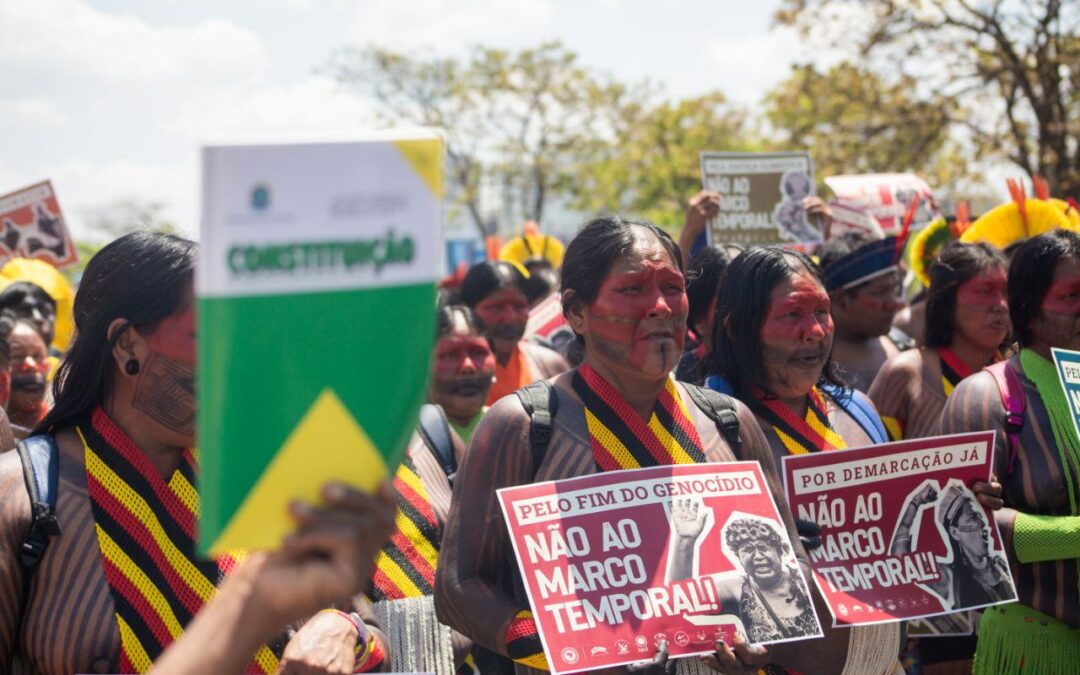
The “Time Frame thesis” is a legal concept asserting that Indigenous peoples are entitled to claim only the lands they inhabited exactly on October 5, 1988, the date of Brazil’s Constitution promulgation. The proposition does not acknowledge the centuries old history of Indigenous Peoples of the country and does not account for the forced displacement they suffered during Brazil’s dictatorship in the 20th century. As a response, the indigenous movement united under the “Our time frame is ancestral” argument.
Indigenous leaders walked through Brasilia next to a large truck that was wrapped to simulate a “train of death”, signalling their opposition to the Ferrogão railing project. The new train route would cut through sacred indigenous lands in the Amazon to facilitate soy exports. Monoculture of soy is one of the leading causes of deforestation and land grabbing, and the train would only aggravate the circumstances.
20/Apr/2024
Photos: Sheyden/ @1sheyden
The largest indigenous mobilization in Brazil will take place from April 22nd to 26th in Brasília (DF).
The theme “Our existence is ancestral. We’ve always been here” marks the 20th edition of the Free Land Camp (Acampamento Terra Livre – ATL), which will be held from April 22nd to 26th at the National Arts Foundation (Funarte) in Brasília (DF). ATL 2024 takes place after the overturning of the Time Frame in the Supreme Federal Court (STF) and the approval of law no. 14,701/2023, which legalized the thesis and various crimes against indigenous peoples last year.
“We continue mobilized and in the fight. ATL is the largest indigenous mobilization in Brazil and the expectation is that ATL 2024 will be the most participatory in history, both in terms of the number of people and the representation of peoples. It’s time for us to come together in assemblies and discuss the next steps,” says Kleber Karipuna, executive coordinator of Apib.
The Free Land Camp is organized by the Articulation of Indigenous Peoples of Brazil (Apib) and its seven regional grassroots organizations: Apoinme, ArpinSudeste, ArpinSul, Aty Guasu, Terena Council, Coaib, and Guarani Yvyrupa Commission.
Indigenous Emergency
The confrontation against the Time Frame thesis is one of the central themes of ATL, as violence against indigenous peoples has intensified. According to data collected by the Protect Collective, in the first month after the approval of Law No. 14,701, six indigenous leaders were assassinated in the country. This data covers the period from December 14, 2023 – the date the law came into effect – to January 21, 2024. During the same period, 13 conflicts were also mapped in territories located in seven states.
One of the assassinations was that of the pajé Nega Pataxó, from the Hã-Hã-Hãe people, during a criminal action by the Military Police of the State of Bahia with the “Zero Invasion” group. The local leader was killed during the retaking of the Caramuru-Paraguaçu territory, in the municipality of Potiraguá.
Apib asserts that Law No. 14,701 represents an action of genocide of indigenous peoples, as the constant violence in the territories is a result of the legalization of the time frame, approved in 2023 by the ruralist caucus of the National Congress, which has promoted various attacks against the rights of indigenous peoples. According to the Articulation, the halt in the demarcation of indigenous lands also exacerbates this scenario of violence.
In 2022, the final report of the Indigenous Peoples Working Group of the Transition Office, of which Apib was a part and coordinated, presented to the Lula Government 14 indigenous lands that were ready to have their demarcations ratified in the first 100 days of the government. However, throughout 2023, only 8 ancestral territories were demarcated by President Lula.
“In terms of demarcation, monitoring, and territorial protection, much remains to be done in the current government,” says Dinamam Tuxá, executive coordinator of Apib.
Mental health
Another theme that will gain prominence in the program is about suicide among indigenous peoples. A study conducted by researchers from the Harvard Medical School (USA) and Cidacs/Fiocruz Bahia (Center for Data Integration and Knowledge for Health of the Oswaldo Cruz Foundation) pointed out that the indigenous population leads the rates of suicide and self-harm in Brazil, but has fewer hospitalizations. According to the study, this reveals the precariousness of medical care and mental health support for indigenous families. The research was conducted with data from 2011 to 2022 and published in the journal The Lancet.
As a result, leaders express concern about the mental health of indigenous peoples, especially those facing invasions in their territories and fighting for their rights.
“It’s suffocating to see this. For over 500 years, we have fought for our lives and territories, but violence against us was legalized last year with the approval of the genocide law. That’s why the temporal framework is the main theme and debate of ATL 2024. Brazil is Indigenous Land and the camp will further highlight this,” says Tuxá.
Event program
The Terra Livre Camp program was developed in collaboration with Apib’s grassroots organizations and can be found in here. The ATL program includes the nationwide pre-ATL activities as part of the “Indigenous April” and “Red April” mobilization.
Additionally, this year the visual identity of ATL was produced with the support of indigenous artist Denilson Baniwa. He, who is also responsible for the conceptualization of the logo of the Articulation of Indigenous Peoples of Brazil, provided Apib with a collection of paintings that were used in the creation of visual elements.
Among the paintings, the highlight in the visual identity is the artwork “Cobra do Tempo” (Time Snake), which now features the colors of urucum red, jenipapo black, and raw cotton, marking the 20 years of the Terra Livre Camp and highlighting the history and path of Brazil’s indigenous peoples.
In 2023, around six thousand indigenous people from approximately 180 tribes participated in the 19th edition of the ATL. “Indigenous Future begins now. Without demarcation, there is no democracy!” was the motto of the last mobilization, which marked the resumption of Indigenous Land demarcations after six years of policy paralysis.
20/Dec/2023
Photo: Kamikia Kisedje
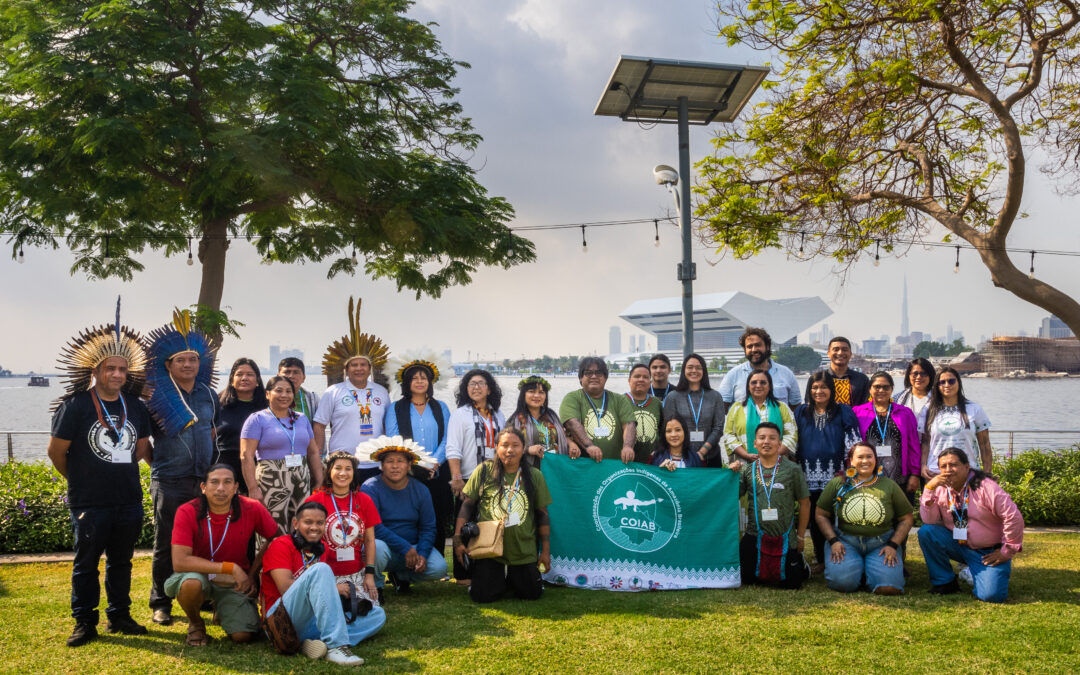
The indigenous delegation in Dubai made history as the largest ever at a Climate Conference, called for the recognition of indigenous territory demarcation as a climate policy and denounced Brazil’s inclusion in Opec+ group, highlighting the grave risks posed by oil exploration projects
COP28 took place in Dubai with the participation of nearly 200 countries and concluded on December 13, a day behind schedule due to negotiations surrounding commitments to reduce fossil fuels in a Climate Conference held, ironically, in one of the world’s major oil-producing regions.
One of Apib’s most urgent demands during COP28 was for the Brazilian government to integrate the existing policy of demarcating indigenous territories into its Nationally Determined Contributions. These contributions are set to be reviewed during COP30 in 2025, which will take place in the city of Belém.
“We leave [Dubai] with the commitment to increasingly press the Brazilian government to implement mechanisms and measures for the protection and demarcation of indigenous territories,” stated Dinamam Tuxá, Executive Coordinator of Apib, in his assessment of COP28. “There is no solution to the climate crisis without Indigenous Peoples and their territories. We need to have our territories demarcated, and we believe our message has reached those it needed to reach,” added Tuxá, referring to the letter that Apib delivered on December 5 to President Lula during a civil society meeting at COP28. The letter underscores the critical importance of ensuring respect for indigenous rights and preventing the advancement of anti-indigenous policies, such as the Marco Temporal Bill, approved on December 14 by the National Congress under Law 14.701/2023.
In addition to the meeting with President Lula, Apib also engaged with Brazil’s negotiators to present its transversal and specific demandsregarding climate negotiations. Key among these demands were the effective participation of Indigenous Peoples in the negotiation process and decision-making and the integration of the policy for demarcation and protection of indigenous territories into Brazil’s Nationally Determined Contributions (NDCs). With a sense of relative satisfaction in mobilizing the largest delegation of indigenous representatives from Brazil at a COP, consisting of approximately 60 indigenous civil society representatives, the indigenous movement centered the debate on the crucial role of Indigenous Lands in national and international climate mitigation policies.
Indigenous peoples are central players in the fight against climate change. Through their deep connection to ancestral territories, they safeguard 80% of the planet’s biodiversity, as demonstrated by United Nations studies. Over the past 30 years, Brazil has lost 69 million hectares of native vegetation, according to MapBiomas. However, only 1.6% of this deforestation occurred in indigenous lands. Preserving all biomes and implementing effective policies against climate change is impossible without ensuring the full usufruct of indigenous peoples in their territories.
One of the main outcomes of COP28 was the Global Stocktake, an evaluation mechanism regarding the implementation status of the commitments of the Parties under the Paris Agreement. The final text of the Global Stocktake makes seven references to Indigenous Peoples, addressing the Parties’ responsibility to respect their obligations to the rights of Indigenous Peoples; the participation of Indigenous Peoples in sustainable and just solutions for the climate crisis and in the negotiation process; the implementation of integrated and multisectoral solutions based on the knowledge of Indigenous Peoples; the respect for Indigenous knowledge as a means of protecting cultural heritage in relation to the impacts of climate change; and the strengthening of capacity-building mechanisms to promote the engagement of Indigenous Peoples in both negotiations and the development of climate policies and actions
For all of this to be truly fulfilled, Brazil must begin by ensuring access to territories as the foremost non-negotiable right for its indigenous populations, as well as respect the ILO Convention 169, which mandates free, prior, and informed consultation regarding projects that impact indigenous territories. Likewise, agreements related to Article 6 of the Paris Agreement must establish complaint mechanisms that are genuinely accessible to Indigenous Peoples. “The text [of the Global Stocktake Report] reflects a political commitment that now needs to be demonstrated in practice. We are not satisfied with having Indigenous Peoples merely mentioned. This [effective participation] requires the inclusion of indigenous peoples in decision-making spaces, benefiting from direct funding, and influencing government policies,” emphasizes Kleber Karipuna, Executive Coordinator of Apib.
New Oil Projects in Indigenous Lands: A Contradiction in the Fight Against Climate Change
Following difficulties in reaching consensus in the negotiations, the final text of COP28 proposed a reduction in global fossil fuel consumption. However, a significant portion of negotiators and civil society feels a certain degree of failure due to the absence of a more assertive and specific mention of the gradual elimination of the use of oil, gas, and coal, rather than just reduction. COP28 set a record for the accreditation of representatives from the oil sector, with 2,456 registered participants.
One of the major contradictions regarding Brazil’s climate stance was the country’s inclusion in the Opec+ group (an extension of the central Opec group, the Organization of the Petroleum Exporting Countries). This move raises concerns among Indigenous Peoples regarding the fossil fuel exploration in their territories, in addition to the climate impacts of such activities. “We leave [COP28 in Dubai] a bit dismayed, understanding that in this COP, even though Brazil played a leading role in climate negotiations, the country joined the Opec+ group. This goes against what is even being discussed: a just energy transition,” explained Tuxá.
The proposal to eliminate the use of fossil fuels was initially included in the draft text of the COP28 agreement but was removed after pressure from Opec and Opec+ associated countries, who voted to eliminate that commitment. The proposal in the final text contradicts the goal of keeping global warming at 1.5º because, as scientists warn, the only path to achieving this is carbon neutrality by 2050, which involves phasing out the use of fossil fuels entirely.
Brazil contributed to the scenario of contradictions that characterized this edition of the Climate Conference, as in addition to the country’s accession to OPEC+, on the same day as the closure of COP28 (December 13), a fossil fuel project auction took place in Rio de Janeiro. The 4th cycle of the Permanent Offer by the National Agency of Petroleum, Natural Gas, and Biofuels (ANP) offered a total of 602 oil blocks and an area with marginal accumulation, totaling an area of 183,569 km². According to data from the Arayara Institute, 15 of these exploratory blocks impact 156 million hectares (47,000 km²) of indigenous lands.
In the Direct Influence Area (AID) of these projects, a total of 23 Indigenous Lands from 9 ethnic groups are affected: Sateré Mawé, Mundukuru, Mura, isolated communities of Pitinga/Nhamunda-Mapuera, isolated communities of Rio Kaxpakuru/Igarapé Água Fria, Kahyana, Katxuyana, Tunayana, and Xokleng, with an estimated affected population of 21,910 indigenous individuals. These indigenous lands are predominantly located in the Legal Amazon region (63.64% of the blocks) in the Amazon Basin (states of AM and PA), as well as in the State of Santa Catarina.
Of these 23 blocks impacting Indigenous Lands, two belong to isolated indigenous communities. Imagine the structures that will be set up next to indigenous territories, in Protected Areas, in quilombola territories, and in the territories of all traditional communities in Brazil. It’s important for us to come together and make a commitment: on the 13th, I won’t participate in the ‘L’ for auction, oil, and gas in my territory,” declared Kretã Kaingang, Executive Coordinator of Apib, who attended the ANP auction in Rio de Janeiro, making a reference to the “Faz o L” manifestation by supporters of President Lula during his election campaign.
The exploration, drilling, extraction, transportation, and even refining and consumption of fossil fuels cause environmental devastation, violence, and local impoverishment. In all phases, there is deforestation and degradation of ecosystems, contamination of water bodies, acid rain resulting from the burning of associated petroleum gas, unbearable noise, and pollution. These facts extend to the natural networks of water and air circulation, as explained by the Arayara Institute.
“In the first term of Lula’s government in 2000, he ratified ILO Convention 169, which grants us the right to free, prior, and informed consultation. For today’s auction, we were not consulted; no affected traditional population was consulted. During COP28, Lula delivered an emotional speech, shedding tears, and talked about reducing deforestation. However, with all the impacts of these oil projects being discussed with the world’s largest oil companies to establish themselves in indigenous territories, why weren’t we, the indigenous peoples standing at the hotel door where the meeting is taking place, allowed to enter?” questions Kaingang at the door of the Windsor Barra Hotel in the capital of Rio de Janeiro.
Brazil, under Lula, which was once a global reference in climate policies, will need to work hard to clarify its contradictions, question whether it continues to tarnish its international image with its membership in the so-called oil cartel Opec+, and fulfill its commitments and goals, including respecting Indigenous Lands, which are guardians of biomes and a significant portion of biodiversity. The country has two years to define a leadership position before COP30 in 2025, organized by Brazil in the city of Belém, where countries will have the significant responsibility of reviewing their climate targets, the NDCs. However, Apib questions the effectiveness of Brazil’s climate commitments as long as policies for the demarcation and protection of territories are not at the center of this debate.
For more information and interview scheduling, please contact:
E-mail: [email protected]
Communication Coordination – Samela Sateré Mawé: +55 (92) 98285 5077
International Coordination: +55 (65) 99686 6289 / +55 (21) 96665 5518 / +55 (92) 99430-3762
29/Nov/2023
Photo: Kamikia Kisedje/ Apib
The government of Brazil has changed, but the Indigenous Peoples, primary guardians of all Brazilian biomes, continue to face threats
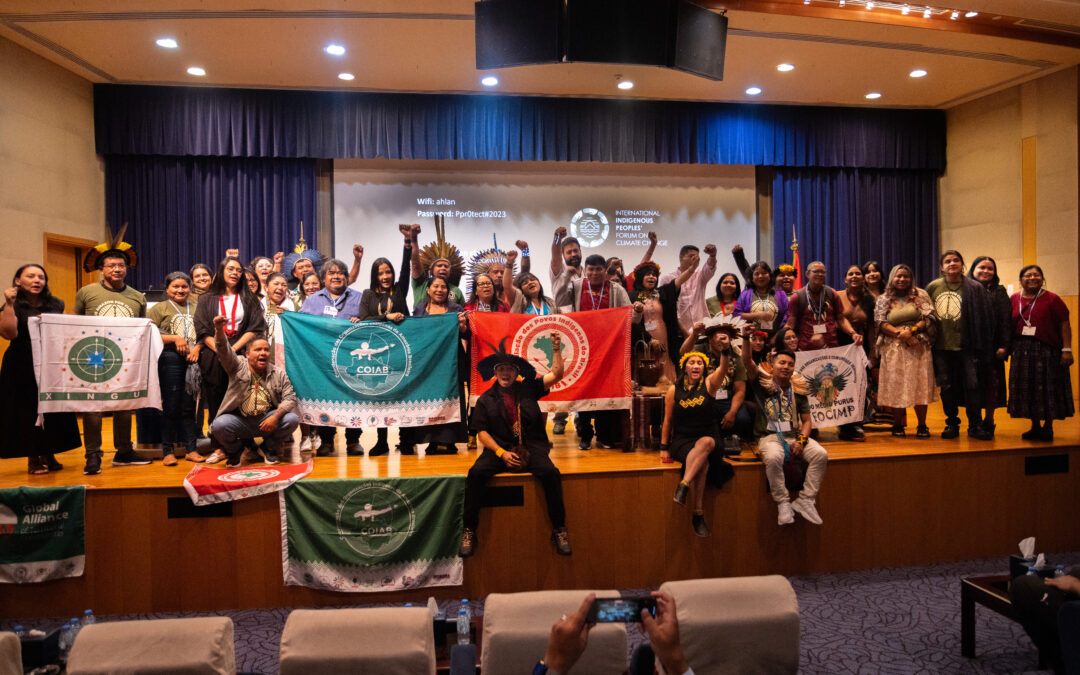
The Articulation of Indigenous Peoples of Brazil (Apib) is participating in the Conference of the Parties on Climate (COP28) in Dubai urgently to relaunch the ‘Indigenous Emergency’ campaign. “We need to denounce that our lives are in danger, the demarcation of Indigenous Lands is being questioned, and the global climate future is at risk. The Congress is pushing forward bills and constitutional amendments that seek to legalize the plunder of our lands and nature in general. It is a legislated Indigenous genocide project,” warns Dinamam Tuxá, executive coordinator of Apib. The first campaign took place during the Covid-19 crisis under the Bolsonaro government, which deeply threatened the lives and fundamental rights of Indigenous peoples. The virus may have passed, but the far-right continues to act against the rights of Indigenous Peoples.
Will Lula fulfill his climate and Indigenous people’s political promises?
The current president, Luiz Inácio Lula da Silva, before taking office, was hailed at COP27 as a “savior,” not only for Brazil but for the global climate future, as there were international concerns about the destructive environmental policies of the former president, Jair Bolsonaro. Brazil is the world’s second-largest country, after Russia, in terms of remaining
forested areas and is a global leader in water resources, holding 12% of the world’s freshwater reserves, mostly preserved within demarcated Indigenous Lands, as studies demonstrate.
In acknowledgment of Brazil’s crucial role in the global climate scenario and in support of the ancestral rights of Indigenous Peoples in Brazil, Lula pledged during the Free Land Encampment (Acampamento Terra Livre) in April 2023 in Brasilia to demarcate all Indigenous Lands still in process by the end of his term. “We, Indigenous Peoples of Apib, supported the election of the current President, but on the occasion of this COP, we need to warn that the demarcation of our lands is at risk, and there is no solution to the current climate crisis without Indigenous Peoples,” emphasizes Tuxá.
Although the Bolsonaro-led far-right anti-Indigenous government has left the Brazilian executive power, it still holds sway in the legislative branch, maintaining a significant majority. Threats to Indigenous Peoples persist, promoted and executed by sectors associated with the far-right. Groups financing campaigns of lawmakers aiming to undermine Indigenous rights to favor national and international agribusiness companies continue to pose a threat.
Who has an interest in ending Indigenous rights?
Those who aim to occupy and profit from Indigenous Lands. Agribusiness comprises national and international companies, with a market primarily focused on international sales. It sustains itself on a solid and longstanding structure, with colonialist foundations formed by politicians and landowners. According to the investigative journalism group “De olho nos ruralistas” representatives of the National Congress and the Executive branch overlap approximately 96,000 hectares of land onto Indigenous Lands. Moreover, many of these politicians were funded by farmers who also encroached upon Indigenous Lands and donated R$ 3.6 million to agribusiness campaign contributions. This group of landowners and invaders funded 29 political campaigns in 2022, totaling R$ 5,313,843.44. Out of this total, R$ 1,163,385.00 was allocated to the defeated candidate, Jair Bolsonaro (PL). |
Lula, who established the first Ministry of Indigenous Peoples in Brazil, couldn’t prevent the progression of certain projects that have now become law. The former controversial PL 2,903/2023, now the Law 14,701/2023 that has come into effect in October 20, threatens the exclusive use of Indigenous Peoples in their lands in case of conflicts of interest with national sovereignty defense policies and legalizes cooperation with non-Indigenous individuals for resource exploitation in Indigenous Lands.
The ruralist thesis of the Time Frame (Marco Temporal) and other points of PL 2903, violating the rights of Indigenous Peoples, were vetoed by Lula. However, lawmakers mobilized by the Parliamentary Agriculture Front (Frente Parlamentar de Agropecuária, FPA) are preparing to overturn the President’s vetoes. The vote, initially scheduled for November 23, has been postponed and remains without a defined date so far.
“Without a majority in the Chamber of Deputies and the Senate, the Lula government needs to negotiate to pass structuring proposals for its current administration, such as the recently approved tax reform. But at what cost? The bargaining chip to pass such a reform has been Indigenous rights,” emphasizes Kleber Karipuna, executive coordinator of Apib.
“We reinforce that our rights are non-negotiable: the Time Frame thesis violates the Constitution, as recently determined by the Federal Supreme Court. These bills progress alongside proposals to amend the Constitution to legalize activities that violate Indigenous rights, such as mining in Indigenous lands,” adds Karipuna.
While anti-Indigenous proposals advance, the National Congress aims to internationally portray Brazil as environmentally friendly through the approval in the Chamber of the so-called “green agenda”. It includes pending measures such as the “future fuel” project to reduce greenhouse gas emissions, including a proposal for carbon storage credit regulation, the National Green Diesel Program, and the National Sustainable Aviation Fuel Program, among other measures.
Who will defend the rights of Indigenous peoples in Brazil at COP28?
“While President Lula balances the forces for national governance and outlines his international speech for COP28, likely to be applauded alongside the brilliant speeches of many other leaders and negotiators, we Indigenous Peoples struggle and resist every day. Speeches do not save us from colonialist projects and the voracious advance of agribusiness. We, Indigenous Peoples, fight not to die and to continue living with our rivers and forests alive in all our standing biomes,” emphasizes Karipuna.
For all these reasons, a commission of Apib leaders is currently in Dubai, and together with the seven regional grassroots organizations, they launch the 2nd edition of the Indigenous Emergency campaign with the theme “Rights are non-negotiable. Demarcation Now!” On Friday, December 1, the second day of the Climate Summit 2023, Apib is going to be a part of the press conference “Indigenous Leadership and Launch of the Indigenous Emergency Campaign.” On Tuesday (5), they are going to be present in the panel discussion “Brazil towards COP30: Indigenous and local community protagonism in confronting the climate crisis.”
It is essential that the voices of Indigenous Peoples be heard in this context of climate policy negotiations; for this reason, Dinanam Tuxá, Executive Coordinator of Apib, will participate on Friday (8) in the Ministerial Event – Launch of the FCLP Dialogue Platform – Indigenous peoples and local communities as leaders of action to halt and reverse forest loss, where heads of States, ministers, and decisive negotiators of COP28 will be present. On the same day, the Apib Fund will be launched during the event “Climate Financing Ecosystem for Indigenous Peoples in Brazil: The unique network of funds managed by Indigenous Peoples.”
Check Apib’s full agenda at COP28 in Dubai
Apib denounces the Indigenous emergency situation in Brazil and reaffirms this urgency in a new manifesto in defense of life and the guarantee of the rights of Indigenous Peoples, deeply threatened by the current advance of ruralists and politicians with agribusiness interests. The manifesto will be delivered to Lula during COP28 and sent to public authorities and civil society actors to highlight the violation of rights and the threats faced by Indigenous peoples.
Additionally, Apib has created the Indigenous Emergency Committee, where Indigenous leaders and other representatives, appointed by Apib’s regional grassroots organizations, will report and discuss threats occurring weekly in territories, streets, networks, and the state.
WE DECIDED NOT TO DIE!
Read the manifesto:
[Portuguese]
https://apiboficial.org/2023/11/14/emergencia-indigena-direitos-nao-se-negociam/
[Spanish]
https://apiboficial.org/2023/11/14/emergencia-indigena-los-derechos-no-se-negocian/?lang=es
[English]
https://apiboficial.org/2023/11/14/indigenous-emergency-rights-are-non-negotiable/?lang=en
Follow the Indigenous Emergency website available in three languages:
[Portuguese] https://emergenciaindigena.apiboficial.org
[Spanish] https://emergenciaindigena.apiboficial.org/es/
[English] https://emergenciaindigena.apiboficial.org/en/
For more information and to schedule interviews, you can contact the Apib press service:
[email protected]
Communication management – Samela Sateré Mawé – +55 (92) 98285 5077
International communication service: +55 (65) 99686 6289 / +55 (21) 96665 5518 / +55 (92) 99430-3762

14/Nov/2023
We, the Articulation of Indigenous Peoples of Brazil (Apib), launched the Indigenous Emergency campaign in 2020 to address the devastating context of humanitarian, health, and political crisis during the Covid-19 pandemic.
We decided not to die!
The pandemic and the anti-indigenous government of Jair Bolsonaro forced us to promote an intense mobilization to confront yet another genocide against our peoples.
Despite several advances in our struggles, threats to our rights, dignity, and the protection of our cultures and territories have intensified.
In 2023, we are relaunching ‘Indigenous Emergency’ because it was never ‘just a virus’!
We are forced to face, in our daily lives, the violence of racism that is deeply rooted in society and in the structures of the State.
Stop killing us!
Invasions, murders, threats, criminalization of leaders, violations of our rights…
Harrowing contexts that have been an integral part of colonization and the military dictatorship that have never ceased to exist for Indigenous peoples.
We must bravely address the violence and homicides inflicted upon women and Indigenous LGBTQIAP+ individuals.
The genocidal project against our peoples, the theft of our ancestral territories, and the exploitation of our natural resources persist with renewed strength, jeopardizing our lives, the reproduction of our cultures, and the very survival of life on the planet.
Rights are non-negotiable!
The ruralist invention of the Time Frame Thesis, regarding the demarcation of Indigenous Lands, has triggered a series of threats at all levels of power.
Legislative proposals such as the PL 2903 and PEC 48 regarding the Time Frame, the PL 191 for mining, PEC 59, and attempts to establish the Parliamentary Commission of Inquiry (CPI) on Demarcations are concrete examples of a state-sanctioned and legislated genocide.
The anti-Indigenous agenda of the National Congress is dominated by lawmakers advocating for the interests of owners of large tracts of land and invaders of our Territories.
We emphasize the Parliamentary Caucus of Agriculture and Mining as spaces created to legitimize our genocide.
The institutional tension brought about by the Time Frame proposition demonstrated a quid pro quo dynamic among the powers of the republic. Indigenous rights became a political bargaining chip.
Since 2016, the Democratic State of Rights has been under constant attack.
First, the political, judicial, and media sanctioned coup against President Dilma, followed by the Temer government, and the rise and electoral defeat of Bolsonarism.
Presently, the traditional right and Bolsonaro allies are actively working within Congress to consolidate influence, challenging the Executive and Judicial branches, prioritizing unconstitutional laws that serve their own economic interests.
The Indigenous movement has achieved historic advances, and we need to emphasize this. Apib brought the indigenous village to the political arena. The ‘Indigenous Campaign’ was central for the strengthening of Indigenous candidacies.
The Cocar Caucus led by Célia Xakriabá strengthens the political frontlines that need to be addressed in the National Congress.
We recognize the creation of the Ministry of Indigenous Peoples (MPI) and the appointment of Indigenous leaders to key positions within the Executive Branch as noteworthy achievements.
Sonia Guajajara as the Minister of MPI, Joênia Wapichana as the president of the National Foundation for Indigenous Peoples (FUNAI), and Weibe Tapeba as the Secretary of Indigenous Health.
The election of President Lula was a collective achievement. However, the electoral context compelled a broad ideological alliance, encompassing conservative and anti-Indigenous economic and political sectors.
Furthermore, the National Congress continues to be dominated by lawmakers backend by national and international corporations and stakeholders in agribusiness, aiming to undermine Indigenous rights.
The Cattle, Bible, and Bullet Caucuses represent a real threat to our lives!
Most State and Local Governments continue to be conservative and anti-Indigenous.
Brazilian politicians, serving in the National Congress and the executive branch, collectively possess 96,000 hectares of land encroaching upon Indigenous Territories.
They are funded by farmers who invade Indigenous Lands, who donated R$3.6 million to the election campaign of ruralists.
It’s a vast amount of land for few farmers.
Environmental degradation, land invasion, and the trampling of people’s rights may worsen with the proposed resurgence of major investments in infrastructure projects, embedded in the so-called PAC III.
Engagement in climate issues and the promotion of Indigenous rights have been on the rise in society.
Simultaneously, assaults and aggressions against Indigenous communities are escalating across all three branches of the Brazilian Republic.
The Lula administration stands at a crossroads, grappling with the task of curbing the enduring social influence of fascist forces despite their electoral defeat.
Lula needs to ensure commitments to the environment and the social movements that elected him while generating employment through economic growth.
For this, the government is banking on large projects, infrastructure developments, and investments, but it makes a mistake by including Indigenous lands in its policies for expanding capital development.
This is not the path to escape the crises that bind us.
The pressure from financial interests triggers a cruel escalation of territorial conflicts and violence, as well as racism, criminalization, and murders.
The problem lies in the configuration of the Brazilian state, which acts as the management committee for the retrogressive interests of the ruralist agenda.
Therefore, we reiterate that our emergency was never just about the Covid-19 virus.
The genocidal project against Indigenous Peoples and the theft of our ancestral territories persists with strength, jeopardizing our lives, the reproduction of our cultures, and the very survival of life on the planet.
We are resuming the ‘Indigenous Emergency’ campaign to structure the response to attacks on the lives of Indigenous Peoples.
We must persist in exposing the power dynamics that daily infringe upon our rights.
We continue to devote all our efforts to inform, strengthen, and mobilize the foundations of the movement for a sustained Indigenous mobilization in defense of our lives, cultures, territories, and rights.
Our response is through democracy, education, organization, and the collective fight for power to the people, united in the defense of the lives of all, in defense of life on Earth.
Our future depends on the demarcation, homologation, protection, and legal security of full and permanent possession of our lands!
We demand the implementation of differentiated public policies, such as education and health. Respect for the Law 11,645, which mandates the teaching of Indigenous and Afro-Brazilian history in the education system.
We need to defeat the ruralist’s political-economic power and reclaim our place in the spaces that shape the direction of our country. There will be no Brazil without Indigenous Peoples.
Tell the people to move forward!