
APIB’s assessment highlights historical achievements, but demands territorial ambition and binding mechanisms for the climate future.
The 30th UN Climate Change Conference (COP30), held in Belém between November 10 and 22, marked an unprecedented moment by placing the territories, voices, and proposals of Indigenous Peoples at the center of the global climate debate. The Indigenous movement arrived with a clear agenda, synthesized in the Indigenous NDC’s, the result of years of multilateral articulation with governments, philanthropy, funds, among other actors. According to APIB and its seven regional organizations, the achievements result from struggle and political articulation, not from voluntary concessions.
“In this COP, there were great advances on the Indigenous agenda, specifically in territorial recognition and demarcations as a mitigation policy. This is a demand of Indigenous Peoples that guided the Federal Government through the NDCs. It is important to emphasize that these advances were not delivered or given, but rather the result of struggle, construction, and dialogue for these manifestations to occur,” said Dinamam Tuxá, APIB executive coordinator for APOINME.
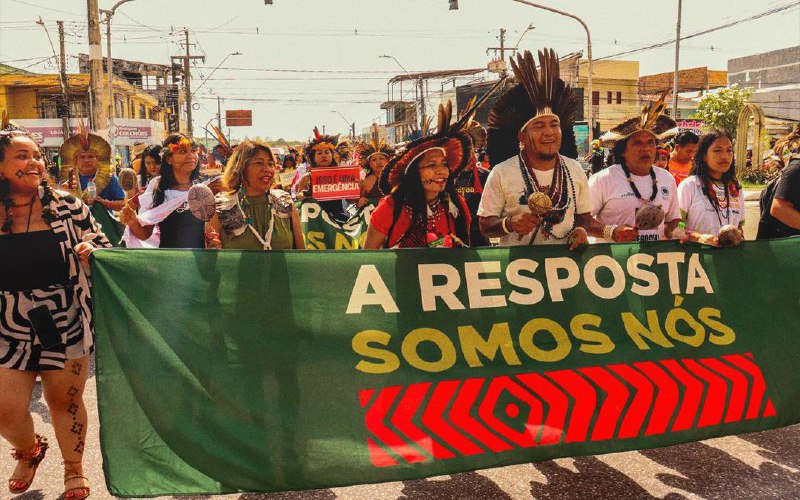
APIB recorded the largest Indigenous participation in the history of the COPs: around 5,000 Indigenous people present in Belém, more than 4,000 Brazilians, and more than 900 accredited in the Blue Zone, surpassing Dubai. The marches were central, especially the Global Indigenous March – The Answer is Us, which brought together more than 3,000 people demanding demarcation and territorial protection.
“There was a significant advance in participation in the Blue Zone, with Indigenous delegations engaged in important debates about the climate crisis. We know that it is still not the ideal number of participation we desire for Indigenous Peoples, but it already represents progress,” said Alberto Terena, APIB executive coordinator for the Terena Council.
The main demand — the recognition of the demarcation and protection of Indigenous territories as climate policy — saw advances with 10 declaratory ordinances, four homologations (official approvals), and six finalized studies. However, the pace remains insufficient: 93 Indigenous Lands are ready for demarcation and awaiting completion.
“This COP 30 had the largest participation of Indigenous Peoples, and although we had some advances in demarcations, we would like them to be broader, especially in territories with a greater number of violent acts,” said Luana Kaingang, Arpinsul coordinator.
Among the institutional advances, the announcement of the Indigenous Land Protection Program (PPTI) stands out, structured on three pillars: demarcation and legal certainty; territorial management led by Indigenous people; and strengthening of organizations with their own financial mechanisms. APIB advocates for co-decisional governance in the program.
Other achievements were: the inclusion of Indigenous Peoples, Local Communities, and Afro-descendant Peoples in the final text; the recognition of the Protection of Indigenous Peoples in Voluntary Isolation and Initial Contact in the Just Transition Work Programme; the presentation of the Indigenous NDC as the only non-state proposal; and international awards received by APIB during COP30.
In the financial sphere, there were concrete announcements. During COP30, the Funders Group on Forests and Tenure (FTFG) announced its second global commitment to support the territorial rights of Indigenous Peoples, local communities, and Afro-descendants — recognizing their central role in protecting forests, biodiversity, and combating the climate crisis. The new commitment foresees an investment of US$1.8 billion between 2026 and 2030.
APIB, through the Global Alliance of Territorial Communities (GATC) and its Shandia Platform, worked for this announcement to materialize and to ensure that resources were not restricted to forest ecosystems but included all biomes, recognizing the Indigenous presence throughout the territory.
Furthermore, more than US$6.6 billion was announced for the Tropical Forest Forever Fund (TFFF), which stipulated that 20% of the payments destined for each country will be directed directly to Indigenous and local community organizations. APIB decided to actively engage in the TFFF co-design process in February 2025, understanding that the initiative represents a concrete opportunity to transform the architecture of climate finance.
Challenges for COP31
Despite the progress, the final COP30 agreement fell short of what is necessary. There was no inclusion of a Roadmap for phasing out fossil fuels and no progress towards zero deforestation by 2030. APIB denounces that the recognition of the importance of Indigenous Peoples was not accompanied by binding mechanisms:
-
Territorial rights need to appear in the operational part of the text, and not just in introductory paragraphs.
-
Free, Prior, and Informed Consent (FPIC) needs to become an operational obligation in climate mechanisms, ensuring binding consent, and not just symbolic consultations.
-
Exclusion Zones free of mining and destructive extractivism in the territories of Indigenous Peoples in Isolation or Initial Contact (PIIRC) were not guaranteed.
-
Law 14.701 (Temporal Framework) continues to limit the effectiveness of demarcations and impose legal uncertainty.
Towards COP31, APIB will continue with the campaign “The Answer is Us,” demanding the implementation of the Indigenous NDC, consolidation of the PPTI, defense of the end of fossils, and guarantee of democratic spaces for social pressure. For APIB, there will be no real climate ambition without territorial ambition.
Access APIB’s report on COP30 here: https://apiboficial.org/2025/11/27/avaliacao-da-articulacao-dos-povos-indigenas-do-brasil-apib-sobre-a-cop30/?lang=en