“Nothing was given”: Indigenous mobilization assesses COP30 and projects decisive agenda for 2026

“Nothing was given”: Indigenous mobilization assesses COP30 and projects decisive agenda for 2026

APIB’s assessment highlights historical achievements, but demands territorial ambition and binding mechanisms for the climate future.

The 30th UN Climate Change Conference (COP30), held in Belém between November 10 and 22, marked an unprecedented moment by placing the territories, voices, and proposals of Indigenous Peoples at the center of the global climate debate. The Indigenous movement arrived with a clear agenda, synthesized in the Indigenous NDC’s, the result of years of multilateral articulation with governments, philanthropy, funds, among other actors. According to APIB and its seven regional organizations, the achievements result from struggle and political articulation, not from voluntary concessions.

“In this COP, there were great advances on the Indigenous agenda, specifically in territorial recognition and demarcations as a mitigation policy. This is a demand of Indigenous Peoples that guided the Federal Government through the NDCs. It is important to emphasize that these advances were not delivered or given, but rather the result of struggle, construction, and dialogue for these manifestations to occur,” said Dinamam Tuxá, APIB executive coordinator for APOINME.

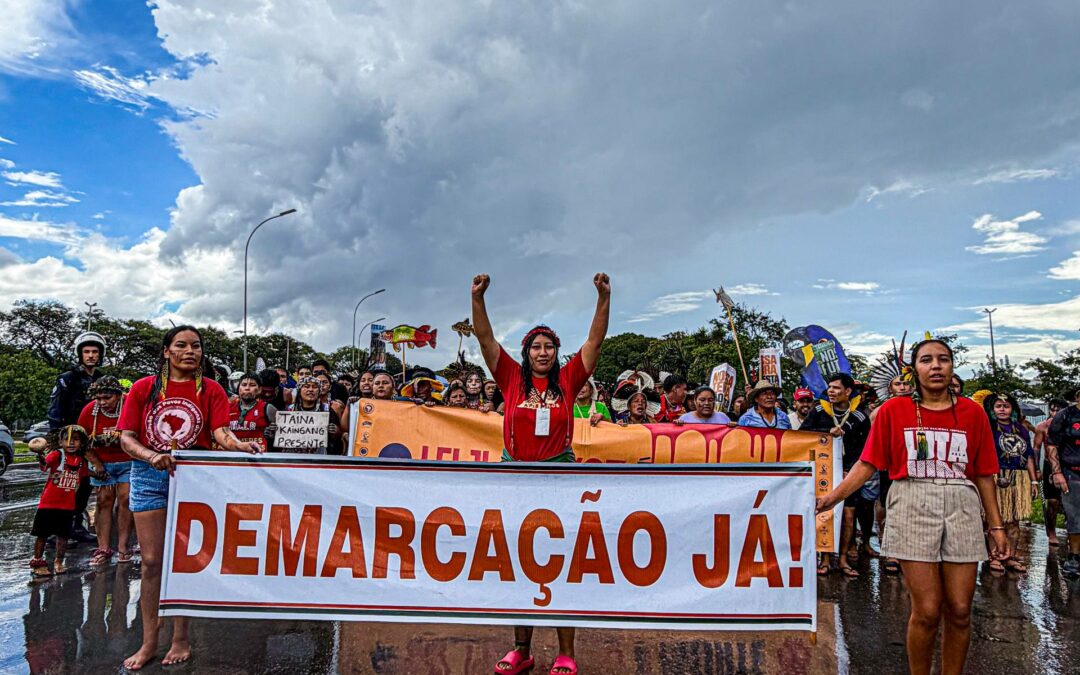
APIB recorded the largest Indigenous participation in the history of the COPs: around 5,000 Indigenous people present in Belém, more than 4,000 Brazilians, and more than 900 accredited in the Blue Zone, surpassing Dubai. The marches were central, especially the Global Indigenous March – The Answer is Us, which brought together more than 3,000 people demanding demarcation and territorial protection.

“There was a significant advance in participation in the Blue Zone, with Indigenous delegations engaged in important debates about the climate crisis. We know that it is still not the ideal number of participation we desire for Indigenous Peoples, but it already represents progress,” said Alberto Terena, APIB executive coordinator for the Terena Council.

The main demand — the recognition of the demarcation and protection of Indigenous territories as climate policy — saw advances with 10 declaratory ordinances, four homologations (official approvals), and six finalized studies. However, the pace remains insufficient: 93 Indigenous Lands are ready for demarcation and awaiting completion.

“This COP 30 had the largest participation of Indigenous Peoples, and although we had some advances in demarcations, we would like them to be broader, especially in territories with a greater number of violent acts,” said Luana Kaingang, Arpinsul coordinator.

Among the institutional advances, the announcement of the Indigenous Land Protection Program (PPTI) stands out, structured on three pillars: demarcation and legal certainty; territorial management led by Indigenous people; and strengthening of organizations with their own financial mechanisms. APIB advocates for co-decisional governance in the program.

Other achievements were: the inclusion of Indigenous Peoples, Local Communities, and Afro-descendant Peoples in the final text; the recognition of the Protection of Indigenous Peoples in Voluntary Isolation and Initial Contact in the Just Transition Work Programme; the presentation of the Indigenous NDC as the only non-state proposal; and international awards received by APIB during COP30.

In the financial sphere, there were concrete announcements. During COP30, the Funders Group on Forests and Tenure (FTFG) announced its second global commitment to support the territorial rights of Indigenous Peoples, local communities, and Afro-descendants — recognizing their central role in protecting forests, biodiversity, and combating the climate crisis. The new commitment foresees an investment of US$1.8 billion between 2026 and 2030.

APIB, through the Global Alliance of Territorial Communities (GATC) and its Shandia Platform, worked for this announcement to materialize and to ensure that resources were not restricted to forest ecosystems but included all biomes, recognizing the Indigenous presence throughout the territory.

Furthermore, more than US$6.6 billion was announced for the Tropical Forest Forever Fund (TFFF), which stipulated that 20% of the payments destined for each country will be directed directly to Indigenous and local community organizations. APIB decided to actively engage in the TFFF co-design process in February 2025, understanding that the initiative represents a concrete opportunity to transform the architecture of climate finance.

Challenges for COP31

Despite the progress, the final COP30 agreement fell short of what is necessary. There was no inclusion of a Roadmap for phasing out fossil fuels and no progress towards zero deforestation by 2030. APIB denounces that the recognition of the importance of Indigenous Peoples was not accompanied by binding mechanisms:

  • Territorial rights need to appear in the operational part of the text, and not just in introductory paragraphs.

  • Free, Prior, and Informed Consent (FPIC) needs to become an operational obligation in climate mechanisms, ensuring binding consent, and not just symbolic consultations.

  • Exclusion Zones free of mining and destructive extractivism in the territories of Indigenous Peoples in Isolation or Initial Contact (PIIRC) were not guaranteed.

  • Law 14.701 (Temporal Framework) continues to limit the effectiveness of demarcations and impose legal uncertainty.

Towards COP31, APIB will continue with the campaign “The Answer is Us,” demanding the implementation of the Indigenous NDC, consolidation of the PPTI, defense of the end of fossils, and guarantee of democratic spaces for social pressure. For APIB, there will be no real climate ambition without territorial ambition.

Access APIB’s report on COP30 here: https://apiboficial.org/2025/11/27/avaliacao-da-articulacao-dos-povos-indigenas-do-brasil-apib-sobre-a-cop30/?lang=en

COP30 Assessment by the Articulation of Indigenous Peoples of Brazil (APIB)

COP30 Assessment by the Articulation of Indigenous Peoples of Brazil (APIB)

Index

  1. Introduction: The Indigenous COP
  2. APIB highlights on COP30
  3. Indigenous Participation at COP30
  4. Achievements of the indigenous movement at COP30
  5. Our vision for the future: what we expect from COP31
  6. Appendix: References to Indigenous Peoples in the Official Documents of COP30

Introduction: The Indigenous COP

COP30 will be remembered worldwide as the Indigenous COP, not only because of the largest indigenous participation in history, but also because we transformed the Climate Conference into a political territory where demarcation, protection and self-determination ceased to be marginal issues and became central to the climate debate.

Since Belém was announced as the host city for the Conference, we have built a collective strategy, articulated from our grassroot organizations, so that COP30 would leave a concrete legacy for the indigenous peoples of Brazil. From this process, the Indigenous NDC was born: including 36 measures that affirm that there can be no real climate action without demarcation, without direct financing, without zones free from exploitation, and without the protection of the peoples who have lived in harmony with the planet for millennia.

We occupied all the advocacy spaces in Belém: the Blue Zone, the Green Zone, the People’s Summit, the COP Village, the streets and the rivers. We also reaffirmed and strengthened our political coordination with other social movements and indigenous peoples at the global level.

While the world listened to us, once again the violence we always denounced prevailed: on November 16, in parallel with the COP, the Indigenous leader Vicente Fernandes Kaiowá was murdered. We reaffirm that there can be no climate solution while those who protect biomes continue to be persecuted and killed, and while unconstitutional laws such as 14.701/2023 (Marco Temporal) promote violence in our territories.

COP30 concludes with historic advances for indigenous peoples: demarcations, financial commitments, structural programs, and the recognition that the protection of our territories is climate policy. We also acknowledge the support of the Minister of Indigenous Peoples, Sonia Guajajara, in the institutional negotiations that resulted in some of the advances presented at COP30.

Each achievement was the result of the tireless mobilization of our leaders, organizations and peoples: nothing was given to us. Even so, the results of COP were insufficient to truly address the climate crisis.

We will continue to fight for concrete measures to end the exploitation of fossil fuels, deforestation and, above all, for the protection of our rights and territories. We made the conference a lively space for debate, courage and purpose. We showed the world that there is no climate future without us. We remain vigilant and continue to fight, because the answer is us.


APIB highlights on COP30


LARGEST INDIGENOUS PARTICIPATION IN THE HISTORY OF THE COPS

  • Over 5,000 indigenous people, being more than 4,000 from Brazil
  • Around 900 indigenous people accredited in the Blue Zone, including around 400 from Brazil
  • More than 500 official and parallel events with indigenous participation, including more than 400 with the participation of leaders from APIB and our regional grassroots organizations

CIVIL SOCIETY MANIFESTATIONS

  • Peoples’ Summit: more than 1,300 civil society organizations and 70,000 participants at the international level
  • COP Village: a reference point for the indigenous delegation, with around 4,000 national and international indigenous peoples
  • Peoples’ Summit Boat Parade (November 12): over 200 boats and approximately 5,000 participants
  • Global Climate March (November 15): more than 70,000 people
  • Global Indigenous March – The Answer Is Us (November 17): more than 3,000 people
  • Dozens of daily acts and interventions

PROGRESS IN LAND DEMARCATION AND PROTECTION

  • Progress in the demarcation of 27 Indigenous Lands:
  • 4 new ratifications
  • 10 declaratory ordinances
  • 6 approvals of Detailed Identification and Delimitation Reports (RCID)
  • 7 ordinances for the constitution of Technical Working Groups (GTs) for the formalization of multidisciplinary studies
  • In addition to advances in the protection of 11 territories:
  • 10 ordinances establishing Indigenous Reserves
  • 1 restrictive use ordinance
  • Commitment by the Brazilian Government to recognize 59 million hectares of indigenous lands in the next 5 years (included in the global commitment by the countries that make up the FCLP to recognize 160 million hectares of indigenous and local community lands by 2030)
  • Official announcement of the Indigenous Land Protection Program (PPTI)

FINANCIAL COMMITMENTS

  • Renewal of the FTFG commitment to allocate US$ 1.8 billion to indigenous peoples and local communities by 2030 (globally)
  • From us, for us: the indigenous and local community funds that make up the Shandia Platform have announced US$ 500 million in direct financing over the next 5 years (globally)
  • We guarantee that at least 20% of TFFF payments will be directly transferred to indigenous peoples and local communities
  • Announcement of the Vítuke Mechanism for Environmental and Territorial Management, with contributions of R$ 150 million

PROGRESS IN THE OFFICIAL COP30 AGREEMENTS

  • Indigenous territories and traditional knowledge recognized as climate mitigation policy.
  • Indigenous participation ensured in building a just transition and fulfilling our rights.
  • Guarantee of free, prior and informed consent and of our self-determination.
  • Protection of Isolated and Recently Contacted Indigenous Peoples.
  • Inclusion of indigenous leadership in climate adaptation and resilience as part of just transition.
  • Explicit recognition of Afro-descendant peoples in official documents.

OMISSIONS IN THE OFFICIAL COP30 AGREEMENTS

  • Failure to adopt the Roadmap to end fossil fuel exploitation and deforestation.
  • Absence of a recommendation that national climate policies incorporate demarcation, surveillance, territorial governance, and indigenous management as pillars for meeting their climate goals.
  • Lack of safeguards and of safe whistleblowing mechanisms against carbon projects and JREDD+ that move forward without consent.

Indigenous Participation at COP30

COP30 saw the largest indigenous participation in the history of the UN Climate Conferences. In total, approximately 5,000 indigenous people were in Belém, including over 4,000 representatives from approximately 300 indigenous peoples in Brazil and about 1,000 indigenous representatives from more than 50 countries.

The event also recorded the largest accredited indigenous delegation in the Blue Zone, the official COP negotiation space: we had approximately 900 accredited indigenous peoples, of whom around 400 were Brazilian. Until then, Dubai had recorded the largest indigenous participation in COPs, with approximately 350 representatives.

Beyond the Blue Zone, our peoples occupied all advocacy spaces during COP30. We had significant participation in parallel events organized in the Green Zone, the official COP30 space dedicated to civil society; at the People’s Summit, our main space for political articulation and convergence with other social movements; in spaces self-managed by civil society in Belém; and in the COP Village, the reference space for the indigenous delegation during COP30, where most of the indigenous delegation was hosted and also where several events were organized by APIB and by our regional grassroots organizations, as well as by the Ministry of Indigenous Peoples and other partners and allies.

We took the streets of Belém in two marches and countless acts and interventions, fighting for our rights and bringing visibility to our demands and contributions. Through our tireless mobilization and advocacy, we succeeded in making the indigenous agenda and the demarcation of our lands the main topic of debate in international media, and the second most discussed topic at the national level, consolidating in the public opinion “the centrality of Indigenous Peoples as protagonists in finding solutions to the climate crisis” [1].

Although we achieved record participation and visibility during COP30, we still do not have formal participation in the negotiation process of the United Nations Framework Convention on Climate Change (UNFCCC), so that our demands could be incorporated into official decisions. Spaces such as the Indigenous Caucus, the Local Communities and Indigenous Peoples Platform, and the Peoples’ Circle are fundamental achievements of the indigenous movement to influence our demands at the climate debate, but we continue to demand direct participation in the negotiations and agreements made within the framework of the Climate Conferences.

The historic indigenous participation in COP30 marked a political and paradigmatic shift: we proved to the world that there can be no climate action without the inclusion of indigenous peoples and territories at the center of climate debate and agreements. This is one of our legacies for the next COPs.

_______________________________________

[1] Digital Public Opinion Monitoring Report, conducted by Quaest, between November 10, 2025 and November 21, 2025. The report states that “Indigenous leaders have become central players in the debate, demanding climate consistency, land demarcation, and limits on fossil fuel exploitation. Their demonstrations were highlighted both in Brazil and on the international stage.”

Events

The indigenous agenda at COP30 was, in terms of numbers and thematic scope, the largest ever recorded at a UN Climate Conference. Over two weeks, our leaders participated in more than 500 official and parallel events, of which more than 400 involved the direct participation of APIB and of our regional grassroots organizations, with over 70 events organized directly by the Brazilian indigenous movement.

This significant volume was not scattered: it was strategic and stems from our historic demand for direct participation in the climate debate. APIB structured its activities in a coordinated manner by subjects, lands and debate priority, ensuring a qualified and geographically representative presence at high-level round tables, technical panels, plenary sessions, civil society spaces, the COP Village, the Green Zone, the People’s Summit and crucial bilateral meetings with governments, multilateral funds, philanthropic organizations and international bodies.

Each event was an opportunity to advocate for our key demands: the demarcation as a mitigation policy; the recognition of the Indigenous NDC; direct funding; our lands as exploitation-free zones; the protection of defenders; a just, sovereign and popular transition; an end to the uncontrolled expansion of the agricultural frontier, among other topics [see below Achievements of the Indigenous Movement at COP30 for more information].

These axes were articulated based on concrete cases, such as the impacts of floodings in Rio Grande do Sul, the severe droughts in the Amazon, the advance of the soy frontiers in MATOPIBA, Cerrado and Pampa, systematic violence against the Guarani Kaiowá and the Pataxó, the impacts of mining on the Kayapó, the Munduruku and the Yanomami peoples, the pressure of deforestation and mining on isolated and recently contacted peoples, as well as several other emblematic cases.

Our national and international political coordination has also gained scale: in events organized with the Global Alliance of Territorial Communities, the Amazon G9, trade unions, the black movement, quilombolas and partner organizations, we have strengthened political alliances and built unified narratives within the scope of our common campaign “The Answer Is Us”.

Such spaces allowed us to challenge official government positions, denounce setbacks and, at the same time, offer solutions based on our traditional ways of life. Among the high-level meetings held with the participation of APIB leaders during COP30, we highlight meetings with:

  • the President of the Federative Republic of Brazil, Luís Inácio Lula da Silva
  • the Secretary-General of the United Nations, António Guterres
  • the Prince of Wales, William Arthur Philip Louis
  • the United Nations Special Rapporteur on the Rights of Indigenous Peoples, Albert K. Barume
  • the United Nations Special Rapporteur on Climate Change, Elisa Morgera
  • the United Nations Special Rapporteur on the Human Right to a Healthy Environment, Astrid Puentes Riaño
  • the Minister for Climate and Environment of Norway, Mr Andreas Bjelland Eriksen
  • the United Nations High Commissioner for Human Rights’ team
  • and several European MPs (from Norway: Lars Haltbrekken – Socialist; Frøya Skjold Sjursæther – Greens; Aleksander Stokkebø – Conservatives; Tor Mikkel Wara, Progress Party; Lisa Badum – Greens; and from Germany: Violetta Bock – The Left; Jakob Blankenburg – SD; Lisa Badum – Greens; Anna Aeikens – CDU).

APIB’s background of resistance and advocacy for land rights and against the climate crisis was recognized by several partners during COP30, including the Finnish Climate Action group, which awarded us the “Climate Champion Award”, and CAN International, which awarded us the “Solidarity and Justice for the Indigenous People of the Amazon” award.

In short, we did not participate in COP30, we shaped COP30: we transformed the Conference into a lively, critical and proactive space, consolidating our indigenous leaders as climate authorities and the indigenous movement as one of the central pillars of global climate governance.

Marches and Demonstrations

The United Nations Climate Conference has not been held in democratic countries since COP26 in Glasgow in 2021. In this sense, the expression of the right to free demonstration by the indigenous movement and civil society as a whole was one of the main highlights of COP30.

There were countless interventions, demonstrations, acts and marches organized and participated in by the indigenous movement, as a historic tool for demanding and fighting for the recognition and the protection of our rights. Among the main interventions carried out with the direct participation of APIB and our regional grassroots organizations, we highlight:

  • Global Indigenous March – The Answer Is Us (November 17): we marched through the streets of Belém with over 3,000 people, demanding the demarcation and the protection of territories, our inclusion and effective participation in negotiating tables, the end of fossil fuel exploitation and the declaration of our lands as exploitation-free zones.
  • Global Climate March (November 15): organized by the People’s Summit, the march brought together more than 70,000 people from various social movements and from all over the world, demanding social, environmental and climate justice.
  • Peoples’ Summit Boat Parade (November 12): the boat parade brought together around 200 boats and approximately 5,000 people from 60 countries in the Guajará Bay, in a symbolic act for COP30 and for climate justice. Indigenous peoples, riverine communities, quilombolas, social movements and organizations from various countries participated in it, all united to denounce false climate solutions and to reaffirm alternatives based on agroecology, solidarity and respect for territories.
  • Vigil: We Are All Guarani Kaiowá (November 17): APIB and Aty Guasu organized the We Are All Guarani Kaiowá vigil in solidarity with the Guarani Kaiowá people following the brutal murder of their leader Vicente Fernandes Kaiowá, which took place in parallel with COP30 (November 16) during the retaking of the Pyelito Kue territory, exposing the violence that continues to affect those who most protect our territories.
  • In addition to these demonstrations, indigenous leaders organized and participated in dozens of daily acts demanding our rights (such as the peaceful demonstration led by the Munduruku people at the entrance to the Blue Zone), which put pressure on Member States and resulted in specific measures being adopted by the Brazilian government (such as the guarantee of Free, Prior and Informed Consultation on the project to build a waterway on the Tapajós River).

These mobilizations put direct pressure on negotiators, countries and the UN. Through our pressure and visibility, we were able to influence public opinion and to constraint on the COP30 negotiations regarding agreements that were being made without our direct participation.

People’s Summit

APIB has been part of the political coordination of the People’s Summit since its creation in March 2023. During COP30, the People’s Summit consolidated itself as the main space of reference and convergence for organized civil society, bringing together more than 70,000 people, representatives of more than 1,300 social movements, civil society organizations and collectives from around the world.

The process of unity in diversity represented by the People’s Summit is strategic beyond COP30, as it strengthens the resistance of our social movements against economic and political interests that have been decimating our peoples and destroying our territories and biomes for centuries.

APIB cosigned the Final Declaration of the People’s Summit, which denounces false market solutions, the inadequacy of the final agreement presented at COP30, the role of capitalism and colonialism in the climate crisis, and the omission of governments in the face of the planetary emergency. The Declaration also incorporated central demands of the indigenous movement, such as the requirement for the demarcation and protection of our territories, direct funding, and an end to the exploitation of fossil fuels.


Achievements of the indigenous movement at COP30

APIB and our regional grassroots organizations have been coordinating strategies for the outcomes of COP30 since November 2022, when the then president-elect Luís Inácio Lula da Silva announced, during COP27, held in Sharm el-Sheikh, the candidature for the city of Belém to host the 30th United Nations Climate Conference, a proposal that was confirmed in December of that year.

Since then, the Brazilian indigenous movement has defined that our main goal for COP30 would be to ensure that the demarcation and the protection of indigenous territories are officially recognized as climate policy and that COP30 leaves a concrete legacy of territorial protection, among other specific demands on the UNFCCC negotiation agenda. This definition stems from the historical accumulation of the indigenous mobilization in the defense of our territories and rights, consolidated through our national assemblies, the Free Land Camp (Acampamento Terra Livre – ATL).

Thus, COP30 did indeed introduce significant advances for the indigenous peoples of Brazil and of the world, with the recognition of our territories as a climate mitigation policy, announcements of demarcation and commitments to territorial recognition and direct funding. We also recognize the important role and leadership of the Ministry of Indigenous Peoples, in the figure of Minister Sonia Guajajara, in promoting the required institutional coordination for several of the announced results, and in building this process over the last few years.

However, the overall picture from COP30 still shows that countries and the UNFCCC are far from recognizing and implementing what is our national and international right, and from promoting an agenda with the necessary climate ambition in the face of the emergency we are experiencing – both in our territories and globally. Without denying sectoral advances, we believe that much more could have been done, especially if States truly had the same ambition for protection that we have for life, ecosystems, future generations, and the planet.

In this scenario, we are fully aware that the advances we have achieved were not voluntary or proactively granted by States or international organizations. We reaffirm that each of the achievements we celebrate is the result of our historic resistance in our territories, of our political articulation from our grassroots to the regional, national and international levels, and of our tireless political advocacy for the defense of our rights.

1. Progress in Demarcations and Land Protection at COP30

We consider the announcements on demarcations to be the main achievement of the Brazilian indigenous movement at COP30, where we had progress on the demarcation of 27 Indigenous Lands. The administrative process for the demarcation of Indigenous Lands in Brazil occurs in seven stages [2]. We celebrate each territory that advances in each stage of demarcation as an additional step towards the exclusive use and full possession of our lands, in accordance with our constitutionally guaranteed right. The 27 demarcation announcements made at COP30 are:

4 Approvals (demarcation stage 6):

  • Kaxuyana Tunayana Indigenous Land (located in the states of Pará and Amazonas)
  • Uirapuru Indigenous Land (Mato Grosso)
  • Estação Parecis Indigenous Land (Mato Grosso)
  • Manoki Indigenous Land (Mato Grosso)

10 Declaratory Ordinances (demarcation stage 4):

  • Vista Alegre Indigenous Land (Amazonas)
  • Tupinambá de Olivença Indigenous Land (Bahia)
  • Comexatiba Indigenous Land (Bahia)
  • Ypoi Triunfo Indigenous Land (Mato Grosso do Sul)
  • Sawre Ba’pim Indigenous Land (Pará)
  • Pankará da Serra do Arapuá Indigenous Land (Pernambuco)
  • Sambaqui Indigenous Land (Paraná)
  • Ka’aguy Hovy Indigenous Land (São Paulo)
  • Pakurity Indigenous Land (São Paulo)
  • Ka’aguy Mirim Indigenous Land (São Paulo)

6 Approvals of Detailed Identification and Delimitation Reports (RCID) (demarcation stage 1):

  • Curriã Indigenous Land (Amazonas)
  • Riozinho Iaco Indigenous Land (Acre)
  • Kulina do Rio Ueré Indigenous Land (Amazonas)
  • Aracá-Padauiri Indigenous Land (Amazonas)
  • Gaviãozinho Indigenous Land (Amazonas)
  • Pindó Poty Indigenous Land (Rio Grande do Sul)

7 Ordinances establishing Technical Groups (GT) for the formalization of multidisciplinary studies (demarcation stage 1):

  • Nadëb Indigenous Land (Amazonas)
  • Maraguá-Mawé Indigenous Land (Amazonas)
  • Tuyuka Indigenous Land (Amazonas)
  • Rio Paracuní e Curupira Indigenous Land (Amazonas)
  • Deni do Rio Cuniuá Indigenous Land (Amazonas)
  • Chandless Indigenous Land (Acre)
  • Kanamari do Jutaí Indigenous Land (Amazonas)

In addition to concrete advances in the process of demarcating these 27 indigenous lands, we also achieved gains in the protection of 11 other territories:

10 Ordinances establishing Indigenous Reserves:

  • Kanela do Araguaia (Mato Grosso)
  • Crim Patehi (Tocantins)
  • Lakiãnõ Xokleng (Santa Catarina)
  • Valparaíso (Amazonas)
  • Uty-Xunaty (Rondônia)
  • Guajanaíra (Pará)
  • Juruna at Km 17 Indigenous Land (Pará)
  • Jenipapeiro (Bahia)
  • Maturêba (Bahia)
  • Nazário e Mambira (Ceará)Besides 1 restrictive use ordinance of the Tanaru Indigenous Land (Rondônia).

These announcements respond to our central demand that COP30 leave a concrete legacy of territorial demarcation and protection. However, there are still hundreds of indigenous territories awaiting recognition and protection. The Brazilian State has a duty to promote demarcation as quickly as possible, especially considering that the constitutional deadline for the Union to demarcate all indigenous territories expired in 1993.

Furthermore, as we denounced on several occasions during COP30, the applicability of Law 14.701/2023, which regulates the Marco Temporal [3] and dismantles our rights, has blocked progress in the demarcation of other territories. The Marco Temporal, which has already been ruled unconstitutional by the Supreme Court, has also proven to be one of the main factors limiting progress in the demarcation of our territories. If Law 14.701/2023 was not in force, we would surely have more announcements of demarcations of other territories during COP30. We demand the immediate repeal of Law 14.701/2023 and of the entire package of setbacks to indigenous rights.

___________________________________________

[2] The seven administrative stages of indigenous land demarcation in Brazil include, in summary: 1) Identification: FUNAI conducts anthropological and technical studies to identify and delimit the Indigenous Land. 2) Approval: The President of FUNAI approves the report and publishes its summary in the Official Gazette. 3) Contestation: Interested parties have up to 90 days to challenge the report; Funai analyses the challenges within 60 days and sends them to the Ministry of Justice. 4) Declaration: The Minister of Justice has 30 days to declare boundaries, request further investigation or reject the identification. 5) Physical demarcation: FUNAI carries out the demarcation; INCRA resettles non-indigenous occupants. 6) Approval: The President of the Republic approves the Indigenous Land by decree. 7) Registration: The demarcated area is registered at a notary’s office and with the Federal Property Secretariat.

[3] Agribusiness thesis that imposes that indigenous peoples would only have rights to territories that they could prove they occupied on 5 October 1988, the date of promulgation of the Federal Constitution of Brazil, disregarding decades of persecution and genocide perpetrated against our peoples, causing many of our peoples to be forcibly displaced from our territories, especially during the military dictatorship that preceded the current Constitution.

2. COP30 Official Agreements: Our evaluation based on the Indigenous NDC

APIB has participated in UN Climate Conferences since COP15, held in 2009 in Copenhagen. However, beyond the COPs, our leaders have been denouncing for decades the climate changes caused by the predatory development model adopted by States, by unbridled capitalism and by the greed for financial profit over life.

While it is true that we have lived in harmony with nature for millennia and inseparably from our territories, it is also true that our peoples have been denouncing the climate emergency we are experiencing today since well before the creation of the United Nations Framework Convention on Climate Change (UNFCCC) and the establishment of the COPs.

To address the current multilateral model of climate change negotiations, we have created the Nationally Determined Contributions (NDC) of the Indigenous Peoples of Brazil, as our guiding document of demands and solutions to be adopted by countries during the COP30 negotiations.

The Indigenous NDC presents 36 proposals divided into seven areas, and was created from our territories up, during several meetings held in 2025, in a constructive process similar to that used in all proposals created by the indigenous movement: representative, collective, politically validated in broad debate, and bottom-up.

The NDC of the Indigenous Peoples of Brazil was a pioneering document, being the first record of this instrument proposed by a non-governmental entity. We are proud that the Indigenous NDC has inspired the creation of NDCs from other social segments, as well as NDCs from indigenous peoples in other countries.

In this sense, the Indigenous NDC is our benchmark for evaluating the agreements, the documents, and the official decisions adopted by countries at COP30. In general, we recognize the advances that have been achieved through indigenous coordination and advocacy for COP30, including the progress of including some of our specific demands in official documents.

However, we condemn the lack of ambition and the omission of Member States which, through insufficient decisions, continue to promote climate collapse and to jeopardise the possibility of life for future generations on our planet. Thus, in relation to the final agreements of COP30:

We celebrate the following measures in the agreements adopted by the Parties at COP30:

  • Recognition of the territories and of traditional knowledge of indigenous peoples as a climate mitigation policy.
  • Recognition of the participation of indigenous peoples in the creation of pathways for just transition, and of our rights to be promoted and fulfilled in just transition initiatives.
  • Guarantee of the implementation of our right to free, prior and informed consent and of our right to self-determination.
  • Protection of Indigenous Peoples in Voluntary Isolation and Recent Contact.
  • Ensuring that climate adaptation and resilience are an integral part of just transitions and must be inclusive and empower indigenous peoples.
  • Explicit recognition of Afro-descendant peoples in official documents.

We condemn the omission of the following measures in the agreements adopted by the Parties at COP30:

  • Absence of a Roadmap to End Fossil Fuel Exploitation and to End Deforestation.
  • Insufficient progress on climate adaptation funding.
  • Absence of a recommendation that national climate policies incorporate demarcation, surveillance, territorial governance, and indigenous management as pillars for meeting their climate goals.
  • Absence of concrete safeguards and safe whistleblowing mechanisms against carbon markets and JREDD+ projects that advance in our territories without the due process of free, prior and informed consent.

In summary, we assess that the final documents agreed upon by the countries represent important advances in the recognition of our rights, highlighting the recognition of our territories and traditional knowledge as a climate mitigation policy, which was one of our central demands for COP30.

We hope that this recognition will be translated into public policies at the national level and that it will result in advances in territorial protection, also from a climate perspective. In the case of Brazil, where deforestation and land use change are responsible for more than three-quarters of the country’s greenhouse gas emissions, and given that indigenous territories are the least deforested areas in the national territory, it is clear that such a measure is central and should be prioritized in Brazilian climate action.

However, States are failing to adopt a concrete proposal to end fossil fuels, and since this is the main driver of global climate change, it is impossible to consider the 30th Climate Conference a success if it does not bring concrete results to address the root causes of the issue. Furthermore, progress towards ending deforestation and adaptation was weak, falling far short of what is needed to honestly address the climate emergency we are experiencing.

Countries lack ambition. Indigenous peoples demonstrated at COP30 that we have the urgency and courage to confront those who are actually jeopardising the possibility of a dignified life for future generations. We demand to be an official part of climate negotiations before it is too late.

3. Intergovernmental Commitment on Land Tenure Commitment by the Forest and Climate Leaders’ Partnership (FCLP)

The Forest and Climate Leaders’ Partnership (FCLP) is a government coalition launched in 2021 during COP26 in Glasgow, bringing together more than 30 countries and the European Union. The FCLP was created with the aim of fostering high-level commitments from these countries on forests, land use and climate, and on the rights of Indigenous Peoples and Local Communities.

During COP30, the FCLP announced the first Intergovernmental Land Tenure Commitment, in which 15 countries committed to a collective and global goal to recognize and secure 160 million hectares of indigenous and local community territories by 2030.

Of this total, 63 million hectares are a commitment made by the Brazilian Government, more than a third of the global target, through demarcation, legal regularization, territorial protection and implementation of the National Policy for Territorial and Environmental Management (PNGATI). The Brazilian target includes 4 million hectares for quilombolas and 59 million hectares for indigenous territories.

APIB, through the Global Alliance of Territorial Communities (GATC), is part of the FCLP Indigenous Peoples and Local Communities Platform (launched at COP28 in Dubai) and, through the Platform, we have been working since 2024 to make the Intergovernmental Commitment on Territorial Recognition a reality at COP30.

4. Official Announcement of the Indigenous Lands Protection Program (PPTI)

The Indigenous Lands Protection Program (PPTI) was officially announced at COP30 as one of the main legacies for the post-Conference period, designed to accelerate demarcation, strengthen territorial management and consolidate the autonomy of indigenous organizations and our financial mechanisms.

The PPTI was created with national coverage and tripartite management — the indigenous movement, the Brazilian Government and international cooperation — structured around three central axes: the demarcation of indigenous lands; the territorial and environmental management; and institutional strengthening of indigenous organizations and financial mechanisms. Its mission is to align institutions, organize resource flows and guide public, international and philanthropic investments, including those announced at COP30, to ensure that territorial protection advances with consistency, efficiency and indigenous leadership.

The proposal revisits and updates successful references from the 1990s, especially the experience of PPG7 and its subprogrammes, such as PDPI and PPTAL — the latter responsible for the demarcation of around 90 Indigenous Lands and more than 60 million hectares in the federal states comprising the Legal Amazon. This trajectory demonstrates that robust mechanisms, built with the direct participation of indigenous peoples, are capable of producing structural and lasting results.

Inspired by this legacy, APIB conducted a participatory process throughout 2025 to develop the PPTI, in partnership with the Ministry of Indigenous Peoples, the National Indigenous Foundation (Funai), and our regional grassroots organizations. The result is a program designed to address the State’s historical shortcomings in territorial demarcation and protection (insufficient financial and human resources), accelerate processes, strengthen indigenous governance and ensure that new financial contributions — such as those from the TFFF and FTFG — reach the territories in a coordinated, transparent manner that is aligned with the priorities of indigenous peoples. The PPTI thus represents the resumption of a structural policy of territorial protection and a strategic step towards consolidating demarcation as a climate policy in Brazil.

5. Renewal of the Forest Tenure Funders Group (FTFG) Pledge

During COP30, the Forest Tenure Funders Group (FTFG) announced its second pledge to support the territorial rights of Indigenous Peoples, local communities and Afro-descendant communities, given that we are key players in halting and reversing deforestation, protecting biodiversity, and advancing climate resilience and adaptation. Therefore, the FTFG announced an investment of US$ 1.8 billion between 2026 and 2030 (globally) to promote initiatives that:

  • Recognize, secure, strengthen, and sustain our land and forest tenure rights
  • Advance community-led conservation, restoration, and climate strategies
  • Reinforce locally-led institutions, including those representing women and youth, and enable them to engage in other climate, biodiversity and rights initiatives
  • Support governments on policy reforms and land use planning and the institutional, financial and social conditions that will protect and enhance such work
  • Facilitate international and national mechanisms advancing our rights

This announcement represents a continuation of the first financial pledge of US$1.7 billion announced by the FTFG in 2021, during COP26 in Glasgow, for the period 2022 to 2025. The commitment came in response to a widely recognized fact: at the time, less than 1% of global Official Development Assistance (ODA) had been directed towards initiatives related to Indigenous Peoples and Local Communities, despite our recognized essential role in ecosystem conservation, climate mitigation and biodiversity protection (Rainforest Norway, 2021).

With the conclusion of the first FTFG pledge in 2025, APIB has been working since 2024, through the Global Alliance of Territorial Communities (GATC) and our Shandia Platform, towards the announcement of this second pledge. Through our advocacy, we have ensured that this new financial commitment is not only for forest ecosystems, but for all ecosystems, recognizing our presence in all regions and the interdependence between all ecosystems. We also celebrate the inclusion of Afro-descendant peoples in the FTFG’s second pledge.

Finally, while we welcome the countries and philanthropic organizations that promoted this second announcement, we reiterate our position that financial contributions to those on the frontline of tackling the drivers of the climate crisis must be more ambitious. In addition, such announcements should stipulate specific direct funding targets that are proportional to our contributions to combating the climate crisis and to protect biodiversity.

6.The Peoples’ Pledge of the Shandia Platform: from us, for us

APIB is one of the five founding members of the Global Alliance of Territorial Communities (GATC), a political platform of Indigenous Peoples and Local Communities representing 36 million people living in territories across 24 countries in Asia, Africa and Latin America. Together, we defend more than 958 million hectares of land. In 2022, we created our Shandia Platform to promote direct access to climate finance for Indigenous organizations and local communities.

During the Shandia Forum 2025, held during COP30, our Shandia Platform announced the first Peoples’ Pledge, a historic commitment to finance US$ 500 million by 2030, from our own territorial financing mechanisms and for our own territories. These resources will be allocated by our own indigenous and local communities funds that are part of the Shandia Platform. In the case of Brazil, our indigenous funds are: Jaguatá, Podáali, FIRN, Rutî, Maracá, Timbira and Pacará.

For the commitments made at this COP to be meaningful, we must be part of them — not as beneficiaries, but as partners who will ensure that the resources actually reach the territories and communities. Our territorial mechanisms have already demonstrated that we are capable of this. We have developed innovative policies, metrics and indicators based on our own concept of direct financing. What remains to be done is for the resources to reach our territories, and the Peoples’ Pledge is our response and our model for the other financial pledges announced at COP30.

7. Guarantee of 20% Direct Funding in the Tropical Forest Forever Facility (TFFF)

The Brazilian government’s main proposal for COP30, the Tropical Forest Forever Facility (TFFF), was officially launched during the Belém Climate Summit (6 nov), which brought together heads of State and preceded COP30 in the capital of Pará. A total of 53 countries signed the TFFF Launch Declaration. The objective of the TFFF is to create a permanent financial mechanism capable of guaranteeing recurring payments to countries and communities that maintain their forests standing, thus contributing to climate change mitigation, biodiversity preservation and the strengthening of sustainable local economies.

To date, US$ 6.6 billion has been pledged for the TFFF, with the guarantee that 20% of TFFF payments allocated to each country will be directly transferred to indigenous and local community organizations. APIB, through the Global Alliance of Territorial Communities and our Shandia Platform, decided to actively engage in the TFFF co-design process in February 2025, considering that the initiative is a concrete opportunity to transform the architecture of climate finance.

This transformation requires explicit inclusion and commitment to direct funding for organizations and mechanisms led by Indigenous peoples and local communities, ensuring that new global financing initiatives are built on the principles of self-determination and the right to meaningful participation.

In addition, we seek to ensure that all resources mobilized through the TFFF are guided by a vision that fully respects and integrates the knowledge, practices and rights of Indigenous Peoples, which are fundamental to the protection of tropical ecosystems. Throughout the design process, APIB, together with the GATC, worked directly to include two specific models of direct funding, ensuring that at least 20% of TFFF resources are allocated to territorial funds and mechanisms led by indigenous peoples and local communities.

Through the TFFF Global Steering Committee for Indigenous Peoples and Local Communities, we will seek to ensure that this commitment is effectively implemented through clear eligibility criteria, social and environmental safeguards, and governance arrangements that respect the self-determination and leadership of indigenous peoples and local communities. Only then the TFFF may ensure its transformative potential and consolidate a new paradigm for global climate finance.

We will also continue to advocate for the 80% of TFFF payments allocated to countries to be applied to indigenous and socio-environmental public policies, such as policies for the demarcation of indigenous lands and territorial protection. We will remain vigilant so that the returns on TFFF investments are not linked to activities that have historically promoted the invasion of our territories and the violation of our rights.

Finally, we reiterate that, while we recognize the potential of the TFFF to promote direct financing for the true protectors of ecosystems, initiatives of an exclusively financial and economic approach should not be prioritized as the only possible strategy to fight the climate crisis. States urgently need to adopt measures that prioritize the territorial rights of ecosystem protectors, and to monitor and ban tax incentives and subsidies for economic sectors responsible for deforestation and rights violations.

8. Announcement of the Vítuke Mechanism for Environmental and Territorial Management

During COP30, the Ministry of Indigenous Peoples (MPI), the National Indigenous Peoples Foundation (Funai) and the Brazilian Biodiversity Fund (FUNBIO) announced the new Vítuke fund – an unprecedented financial mechanism designed to boost the National Policy for Indigenous Environmental and Territorial Management (PNGATI). To date, contributions of approximately US$ 30 million have been announced, while the fund seeks to mobilize US$ 110 million.

The mechanism aims at allocating resources to projects that promote the consolidation of territorial and environmental management in indigenous territories, considering six areas of action: territorial and natural resource protection; indigenous governance and participation; prevention and restoration of environmental damage; sustainable use of natural resources and productive initiatives; capacity building, education and exchange of knowledge; and management infrastructure.

APIB participated in workshops to establish the Vítuke fund and hopes that this mechanism can be integrated into the second axis of the Indigenous Lands Protection Program, which is dedicated to the Territorial and Environmental Management of Indigenous Lands.

9.The Answer Is Us: Resistance and Global Solidarity

During COP30, The Answer Is Us campaign established itself as one of the main global movements for climate justice. Launched in 2024, the campaign gained even more international visibility in Belém, being seen in marches, in the People’s Summit events, in the COP Village plenary sessions, in the People’s Circle panels, in international side events, and in graphic materials inside and outside the Blue Zone. To learn more about the campaign and our six core demands, visit The Answer Is Us website.

Our campaign promotes common demands, unity, and global solidarity among all actors truly interested in fighting the climate crisis, including indigenous peoples, traditional peoples and local communities, small farmers, quilombolas, fishermen, extractivists, shellfish gatherers, city workers, trade unionists, homeless people, babaçu coconut breakers, terreiro peoples, women, the LGBTQIAPN+ community, young people, Afro-descendants, the Palestinian people, the elderly, and the peoples of the forest, of the countryside, of the outskirts, and of the seas, rivers, lakes and mangroves.

Regarding the six core demands of our campaign, APIB assesses that we made significant progress at COP30 in relation to “Land Rights = Climate Action,” through the official recognition of indigenous territories as a climate mitigation policy; and in relation to “Direct Access to Climate Finance,” due to the announcements and commitments made at COP30, mainly in relation to the 20% direct financing guaranteed in the TFFF mechanism, in relation to the Shandia Platform Peoples’ Commitment and, to a certain extent, in relation to the second financial pledge of US$ 1.8 billion made by the FTFG.

However, less significant progress was seen on “Zero Deforestation,” on “No to Fossils Fuels, No to Mining in our Territories,” on the “Protect Defenders, Protect our Ways of Life” and on “Participation with Real Power.” In any case, we have managed to raise awareness of our agenda in the negotiating rooms and on the streets, and we will continue to pressure States and fight so that our voices are heard and our messages are adopted. After all, we know that, more than ever, the answer to the climate crisis is us.


Our vision for the future: what we expect from COP31

COP30 marked a turning point: we proved to the world that Indigenous Peoples are not just participants in the climate debate – we are the frontline and the main source of real solutions. We have achieved historic victories in demarcation, territorial protection and direct financing, and we have transformed Belém into the global epicentre of the fight for climate justice. But we know that in order to address the climate crisis with the necessary responsibility and urgency, COP31 needs to go much further.

The transition from COP30 to COP31 comes at a critical moment: Belém portrayed the strength of a COP in a democratic environment, where social movements and indigenous peoples could influence decisions and place demarcation at the center of the climate agenda. But the hosting of COP31 in Turkey, co-chaired with Australia, raises concerns about restrictions on social demonstrations, risks to the safety of defenders, and the influence of the oil lobby in the negotiations, indicating a structural shift in the political conditions of the climate negotiating process. Therefore, we will remain vigilant to prevent setbacks and preserve the strength gained in Belém.

Our expectation is that COP31 will consolidate the paradigmatic change we have initiated. The recognition that indigenous territories are climate policy must translate into concrete actions: more demarcations, effective protection, and public policies that include our territories as central pillars of mitigation and adaptation. COP31 must demand specific targets, clear timelines and accountability mechanisms from States to fulfil their commitments – including presenting results on the implementation of the territorial recognition target set out by the FCLP land tenure commitment.

We also hope that COP31 will advance what COP30 did not have the courage to address: the end of fossil fuel exploitation and the adoption of a roadmap for its elimination. There will be no possible future as long as oil, gas and coal continue to drive the global economy. We will actively engage at the First International Conference on the Just Transition Away from Fossil Fuels, scheduled to take place in April 2026, and we demand that COP31 establishes binding targets, robust socio-environmental safeguards and the centrality of human rights in the energy transition process.

Direct financing must cease to be a promise and become a structural practice of the international climate system. COP31 must advance to guarantee full and unbureaucratic access to financial mechanisms for indigenous peoples, local communities and traditional peoples, strengthening our own funds, governance and territorial priorities. We no longer accept models that treat us as beneficiaries: we are implementers, managers and formulators of solutions.

We also hope that COP31 will be the moment to correct serious gaps: safeguards to prevent abuses in carbon and JREDD+ projects; binding recognition of free, prior and informed consent; effective protection for defenders; and formal mechanisms for indigenous participation in the UNFCCC decision-making processes. The record participation of Indigenous Peoples at COP30 must be constant in future COPs.

The world has already understood that there is no climate future without protected territories, and that there are no protected territories without respect for indigenous rights. We will continue to spread our message: there is no time for omissions, false solutions or weak agreements. The climate crisis requires courage, and we have already demonstrated ours. Now, States need to demonstrate theirs. Because, as we stated in Belém and will state again at COP31, the answer is us, all of us.


Appendix: References to Indigenous Peoples in the Official Documents of COP30

APIB shares below the main references to Indigenous Peoples included in the official COP30 documents.

Mitigation ambition and implementation work program

  • Recognizes the vital role of indigenous peoples and local communities and the need to support them in the sustainable management and use of forests, as well as the importance of recognizing their land rights and traditional knowledge, including as part of long-term mitigation policies.

Just Transition work program

  • Determines the importance of ensuring broad and meaningful participation involving all relevant stakeholders, including indigenous peoples, to enable transition pathways that are fair, effective, inclusive and participatory.
  • Determines the importance of just transition pathways that respect, promote and fulfil all the rights of indigenous peoples.
  • Recognizes the importance of the rights of indigenous peoples and of obtaining their free, prior and informed consent, in accordance with the United Nations Declaration on the Rights of Indigenous Peoples, and the importance of ensuring that all just transition pathways respect and promote the internationally recognized collective and individual rights of indigenous peoples, including the rights to self-determination; that the rights and protections of indigenous peoples in voluntary isolation and initial contact, in accordance with relevant international human rights instruments and principles; and that climate adaptation and resilience are an integral part of just transitions and must be inclusive and empower indigenous peoples, local communities, women and people in vulnerable situations.
  • Underlines that relevant instruments and initiatives can provide elements to be taken into account in the design and implementation of nationally determined just transition pathways, including the International Labour Organization guidelines for a just transition to environmentally sustainable economies and societies for all, the United Nations Global Accelerator for Employment and Social Protection for Just Transitions, the United Nations Guiding Principles on Business and Human Rights and the United Nations Declaration on the Rights of Indigenous Peoples, and calls on partners in relevant initiatives and organizations outside the UNFCCC process to take into account the key messages of the work program in their implementation efforts.

Belem Declaration on Fighting Environmental Racism

  • Recalls the commitments made under the United Nations Framework Convention on Climate Change and the Paris Agreement adopted under its auspices to respect, promote and consider human rights, the rights of Indigenous Peoples, gender equality, intergenerational equity and the needs of people in vulnerable situations in climate action.
  • Recognizes that environmental racism — often manifested in policies and practices that result in disproportionate exposure of people and communities, including people of African descent, Indigenous Peoples, and local communities, to environmental damage and climate risks — contravenes the principles of equality and non-discrimination enshrined in international human rights law, while recognizing the commitment and progress made by States in addressing this issue.
  • It calls on all nations to cooperate in the essential task of combating environmental racism, recognizing that sustainable development will only be achieved when the inequalities that disproportionately affect people of African descent, Indigenous Peoples, traditional communities and other vulnerable groups and minorities in all regions of the world are eliminated.
  • It also invites all States to strengthen collective efforts to build just and inclusive societies by combating environmental racism, ensuring the full participation of people of African descent, Indigenous Peoples and local communities, and progressively raising the collective ambition to reduce disparities in living standards and better meet the needs of the majority of the world’s population.

Global Mutirão: Uniting humanity in a global mobilization against climate change


  • Determines that countries, when taking action to address climate change, must respect, promote and consider their obligations in relation to the rights of indigenous peoples, as well as their territorial rights and traditional knowledge.
  • It emphasises that countries should consider the role and active involvement of indigenous peoples in supporting the Parties and contributing to meaningful collective progress towards the long-term goals set in the Paris Agreement, as well as in addressing and responding to climate change and strengthening ambition and implementation, including progress achieved through other relevant intergovernmental processes.

APIB Public Statement to the Press

This edition of the COP is taking place in a democratic country, where the right to protest is guaranteed and respected, unlike previous editions held in more restrictive contexts.

In this regard, the Articulation of Indigenous Peoples of Brazil (APIB), together with its regional organizations, became aware of a demonstration held today (November 11) organized by social movements with the participation of some Indigenous peoples. APIB reaffirms that the Indigenous movement is broad and diverse, and that this organization did not coordinate the activities of the mentioned demonstration. At the same time, APIB reiterates its respect for the right to protest and for the autonomy of each people in their own forms of organization and political expression.

We are in the city of Belém with more than 3,000 Indigenous people, both Brazilian and international. Indigenous peoples are not part of the official COP30 negotiations, but we have been engaging politically for over two years to ensure that our demands are heard and incorporated into decisions addressing the climate crisis.

At the same time, the Indigenous movement is broad and diverse. APIB upholds the autonomy of all peoples to express themselves freely and democratically, without any form of paternalism — the kind that the State imposed on us for so many years.

The Indigenous movement knows why we are here and understands the space we occupy: we are here to keep demanding real commitments and to reaffirm that the answer is us.

In Belém, Pará’s capital, indigenous movement demands a legacy of land demarcation and territorial protection for COP30

APIB mobilizes over 3,000 indigenous people and proposes goals in conference negotiations

Leaders of the Articulation of Indigenous Peoples of Brazil (APIB) and its regional organizations are participating, starting today, November 10, in the United Nations (UN) Climate Change Conference of the Parties, COP-30, in Belém, Pará. APIB, a national reference for the indigenous movement in the country, demands that the demarcation and protection of Indigenous Lands be the legacy left by the conference in Brazil.

“Our peoples, territories, and traditional ways of life are part of the solution to combat the climate crisis, but unfortunately, the Conference of the Parties does not officially consider indigenous peoples as negotiators. That is why we have been pressing them for months so that the demarcation of Indigenous Lands is at the center of the agenda. We will also mobilize in the streets and show that change needs to happen now,” affirms Dinamam Tuxá, executive coordinator of APIB.

Brazil currently has 107 Indigenous Lands (TIs) ready to be demarcated and awaiting the finalization of the process: 37 are waiting for the declaration ordinance and 70 for the homologation ordinance. Most of the TIs awaiting homologation, the last stage of the process, are concentrated in Mato Grosso do Sul and São Paulo (10), followed by Amazonas (9) and Pará (8). The data is part of a survey by the Articulation of Indigenous Peoples of Brazil (Apib). But the demand for demarcation is even greater: another 161 TIs are in earlier stages of the demarcation process, revealing the dimension of the challenge faced by the indigenous movement in the fight for the guarantee of their recognized and protected territories.

Advancements

Kleber Karipuna, executive coordinator of APIB, comments that the articulations for COP30 began two years ago and resulted in announcements of commitments even before the official start of the COP, such as the one announced by the Forest and Climate Leaders’ Partnership (FCLP), which ensures the unprecedented commitment to a global goal of recognizing indigenous and local community territories, including demarcation goals for the next five years.

Furthermore, we had the guarantee of at least 20% of the Tropical Forests Forever Fund (TFFF) resources destined for direct access by indigenous peoples and local communities, and the Forest Tenure Funders Group (FTFG) announced on November 6 a new financial commitment of US$1.8 billion for actions related to strengthening the land tenure rights of Indigenous Peoples and Local Communities (IP&LCs).

“The articulation of the indigenous movement, not only Brazilian but globally, has been intense over the last two years. The goal was to arrive at COP30 with concrete proposals. In partnership with the Global Alliance of Territorial Communities, the work to ensure a commitment to territorial recognition was also crucial. This commitment was developed jointly with the FCLP, aiming for countries and combined forces worldwide to recognize the territories of indigenous peoples, local communities, traditional peoples, quilombolas, and conservation areas. The recognition of these lands is fundamental for achieving global climate goals,” says Kleber Karipuna, executive coordinator of APIB.

Program

For COP30, the Articulation divided its strategies into five axes: strengthening the “We Are the Response” Campaign, political articulation with the Peoples’ Summit and the Global Alliance of Territorial Communities, advocacy in the COP30 negotiations through the elaboration of the Indigenous Nationally Determined Contribution (NDC), action agendas, and the promotion of indigenous governance and participation in COP-30.

In total, more than 3,000 indigenous people are expected to participate in COP30, which runs until November 21. The COP is divided into two official spaces: the blue zone and the green zone. This year, APIB’s delegation has about 360 people credentialed for the blue zone, the restricted space of the conference focused on climate negotiations. However, APIB leaders will also join forces in the Green Zone, at Aldeia COP, at the Peoples’ Summit, and in events in various civil society spaces in the city of Belém.

Among the highlights of the program is the opening of the Indigenous COP at Aldeia COP, located at the Application School of the Federal University of Pará (UFPA), on November 12. The space is organized by the Ministry of Indigenous Peoples (MPI) and supported by the indigenous movement.

The indigenous movement’s agenda also includes two marches: the Global Peoples’ March, organized by the Peoples’ Summit, will be held on November 15, and the Global Indigenous March – We Are the Response on the 17th.

To learn more details about the program and APIB’s strategies for COP30, visit the organization’s website: https://apiboficial.org/cop-30/.

Global voices unite in the campaign “The Answer Is Us” in an urgent call for climate justice and defense of life towards COP30

Global voices unite in the campaign “The Answer Is Us” in an urgent call for climate justice and defense of life towards COP30

Photo: @owapichana/ APIB

The official site of the “The Answer Is Us” campaign is now available.

The campaign “The Answer Is Us” echoes voices from different territories — peoples of the forests, the waters, the countryside and the cities — in an urgent global mobilization for climate and life, leading up to COP30, which will be held in November, in Belém (PA). All information can be accessed at theanswerisus.org 

The members of the campaign reinforce that science confirms what ancestral knowledge always flagged: there is no climate justice without territorial, social and popular justice.

The campaign was created by the Indigenous Peoples of the Amazon and Brazil, launched by the COIAB (Coordenação das Organizações Indígenas da Amazônia Brasileira) in June 2024. It was then joined by APIB (the Articulation of Indigenous Peoples of Brazil), the Amazon G9 and the Global Alliance of Territorial Communities, gaining strength at national and international level. Now, it also includes social and activist movements from different parts of the world.

Campaign demands:

  • Land Rights = Climate action: proteger territórios é proteger toda a vida no planeta. Sem reforma agrária, demarcação, titulação, regularização fundiária e proteção integral, não haverá ecossistemas capazes de conter o colapso climático.
  • Desmatamento zero: frear a destruição que gera grandes emissões de carbono e devasta os ecossistemas reguladores do clima global é uma urgência.
  • Não aos combustíveis fósseis e à mineração: petróleo, gás e carvão são os principais causadores da crise global, e essa indústria bilionária precisa ser desmontada. A campanha também rejeita projetos de transição energética que violem territórios, exigindo uma transição justa, soberana e que priorize a vida sobre o lucro.
  • Proteção dos defensores e modos de vida: é necessária proteção imediata e integral para quem defende a terra, as águas, as florestas e o clima. Não haverá política climática justa enquanto persistir a impunidade e violência.
  • Acesso direto ao financiamento climático: os recursos para enfrentar a crise devem chegar diretamente a quem está na linha de frente — povos da floresta, das águas, do campo e das cidades. A campanha exige repasses sem burocracia colonial ou intermediários.
  • Participation with real power: COP30 will be held in the Amazon. We demand a dignified, permanent presence with real power in decision-making. We will not accept playing the part of extras in a stage that decides the fate of the climate—and our lives—far away from us. Climate justice is built with real participation, not behind closed doors.

Call for global mobilizations

APIB calls on organizations and individuals to mobilize in communities, streets, squares, and centers of power. The next mobilization of the “We Are the Answer” campaign will be on October 13th.

Partner organizations are encouraged to hold demonstrations in their territories and use the mobilization materials available in Portuguese, English, Spanish, French, and Bahasa on the campaign website—posters, banners, and t-shirts are already ready for use.

APIB condemns acts of violence by anti-indigenous Congress

APIB condemns acts of violence by anti-indigenous Congress

Photo: Richard Wera/Apib

The Articulation of Indigenous Peoples of Brazil (APIB) vehemently condemns the acts of violence by the anti-Indigenous Congress, carried out by the Legislative Police Department (DPOL) and the Military Police of the Federal District (PMDF) on the afternoon of Thursday, April 10, during the “We Are the Response” march, which is part of the Free Land Camp (ATL) program.

In addition to approving unconstitutional laws, Congress attacks Indigenous Peoples and even its own deputies. Indigenous Congresswoman Célia Xakriabá (PSOL) and several others were injured when they were met with pepper spray and stun grenades — in what should be the house of democracy. We deeply regret the unnecessary use of chemical substances against demonstrators, including women, elders, children, and traditional leaders.

We have evidence that these actions are part of a broader context of institutional violence against Indigenous Peoples. Yesterday, during a meeting convened by the Public Security Secretariat of the Federal District (SSP-DF) to discuss the organization of today’s march, an unidentified participant made a racist and violence-inciting statement: “Let them come down already… let them come down and beat them if they cause trouble.” As recorded in audio obtained by APIB upon request after the meeting, the statement was allegedly made by a probable security force agent.

Today, access to the lawn of the National Congress by the demonstrators happened spontaneously and without any violence, vandalism, or breach of barriers. APIB reaffirms the peaceful and democratic nature of the protest, which brought together over 7,000 Indigenous leaders from various peoples across the country.

The mobilization aimed to defend constitutional rights and strengthen dialogue with the branches of the Republic. The Free Land Camp has been held for over 20 years in the federal capital, always marked by strong organization, commitment, and respect for democratic institutions. Throughout these two decades, the Indigenous movement has always cooperated and will continue to do so to ensure the event takes place peacefully and safely.

Free Land Camp 2025
Articulation of Indigenous Peoples of Brazil – APIB
Brasília, April 10, 2025

APIB launches Indigenous NDC and International Commission for COP-30

APIB launches Indigenous NDC and International Commission for COP-30

Photo: _ @sallynhandewa

With the launch of an Indigenous NDC and the creation of an international commission, APIB strengthens the participation of Indigenous Peoples on the road to COP-30 in Belém.

The Articulation of Indigenous Peoples of Brazil (APIB) will launch today (April 10), at the Free Land Camp (ATL), an Indigenous Nationally Determined Contribution (NDC). In addition, the Ministry of Indigenous Peoples will announce an Indigenous International Commission for the United Nations Climate Change Conference (COP-30), which will take place in November in the city of Belém (Pará).

The NDC and the commission will be announced at the plenary “We Are the Answer: Indigenous Peoples on the Road to COP-30,” at the ATL, starting at 2 p.m., with the presence of Ambassador André Corrêa do Lago, president of COP-30. Ministers Sonia Guajajara, from the Ministry of Indigenous Peoples (MPI), and Marina Silva, from the Ministry of Environment and Climate Change (MMA), along with Federal Deputy Célia Xakriabá, who will also join the panel. These actions are part of the global campaign “We Are the Answer,” led by the Indigenous movement, which asserts that Indigenous Peoples and the demarcation of Indigenous Territories are essential in the fight against the climate crisis.

Developed from the accumulation of proposals by APIB’s regional organizations, the Indigenous NDC reinforces that the climate debate must consider equity, self-determination, and the effective participation of Indigenous Peoples and traditional communities in the implementation of Brazil’s NDC under the Paris Agreement.

The document is divided into six thematic axes:

  • Mitigation, which defends the recognition and protection of territorial rights as essential climate mitigation policy;
  • Adaptation, which highlights the importance of protecting ancestral knowledge, such as fire management and indigenous medicine;
  • Financing, which proposes revising existing mechanisms and creating specific tools for the direct funding of indigenous organizations;
  • Technology transfer, which suggests integrating traditional knowledge with modern science in climate strategies;
  • Capacity-building, focused on technical training and access to climate information in accessible language;
  • Justice and ambition, which recognizes the historical debt owed to indigenous and traditional peoples;
  • Co-benefits, which links land demarcation to climate action, strengthening Brazil’s international commitments.

“The document is based on climate justice, the right to free, prior and informed consent, and the importance of solutions that respect nature and are conceived and led by Indigenous Peoples,” says Dinamam Tuxá, executive coordinator of APIB.

Commission for the Conference of the Parties
With the mission of amplifying the visibility and influence of Indigenous Peoples in climate negotiations, the Indigenous International Commission for COP-30 will be chaired by Minister Sonia Guajajara and will include the following organizations: APIB, COIAB, ANMIGA, the G9 of the Amazon, the Global Alliance of Territorial Communities (GATC), and the United Nations Permanent Forum on Indigenous Issues (UNPFII). There is also dialogue to include other international Indigenous organizations and forums.

“The commission is a platform that seeks to advance Indigenous rights, resilience, and climate leadership. At COP-30, we have the opportunity to ensure the best and largest indigenous participation in history. Our goal is to have one thousand accredited Indigenous representatives in the Blue Zone,” says Minister Guajajara.

The commission’s responsibilities include developing a methodology to guarantee Indigenous Peoples’ accreditation for the Conference of the Parties as an institutionalized practice for future COPs; ensuring focus on the specific priorities of Indigenous Peoples; conducting regional meetings; and planning and implementing high-level events and meetings with state parties, UN agencies, and allies to amplify indigenous demands.

International Participation at ATL 2025
The 21st edition of the Free Land Camp is marked by the participation of international indigenous delegations. Indigenous representatives from more than 15 countries are participating, including from the eight Amazon Basin countries, Australia, and Fiji, as well as leaders from the Global Alliance of Territorial Communities (GATC), which represents Indigenous Peoples and local communities from 24 countries.

According to APIB, the organizations participating in the mobilization include: Interethnic Association for the Development of the Peruvian Rainforest (AIDESEP), Amerindian Peoples Association (APA – Guyana), Confederation of Indigenous Nationalities of the Ecuadorian Amazon (CONFENIAE), Confederation of Indigenous Peoples of Bolivia (CIDOB), Federation of Indigenous Organizations of French Guiana (FOAG), Organization of Indigenous Peoples of Suriname (OIS), National Organization of Indigenous Peoples of the Colombian Amazon (OPIAC), Regional Organization of Indigenous Peoples of the Amazon (ORPIA), and the Global Alliance of Territorial Communities.

On April 10, the delegations will participate in the “Meeting with Embassies: We Are the Answer – Indigenous Peoples’ Visions for COP-30,” with the aim of bringing Indigenous demands to the embassies of Germany, Austria, Australia, Canada, Denmark, Spain, France, Finland, Ireland, Norway, the Netherlands, Peru, the United Kingdom, Sweden, Switzerland, and the European Union. Also participating will be the Ministry of Indigenous Peoples, Ministry of Environment and Climate Change, Ministry of Foreign Affairs, and the German Agency for International Cooperation (GIZ).

ATL 2025 brings together over 7,000 Indigenous participants at the National Arts Foundation (Funarte) in Brasília. Under the motto “We Are the Answer,” on April 10 at 4 p.m., Indigenous Peoples will march through the streets of the federal capital to the Plaza of the Three Powers.


“We are all APIB: In defense of the Constitution and life” is the theme of ATL 2025

“We are all APIB: In defense of the Constitution and life” is the theme of ATL 2025

The largest indigenous mobilization in Brazil will be held between April 7 and 11 in Brasília (DF)

On the National Day of Struggle of Indigenous Peoples, February 7, the Articulation of Indigenous Peoples of Brazil (APIB) reveals the theme chosen for the Acampamento Terra Livre (ATL) 2025. “APIB is all of us: In defense of the Constitution and life” reinforces the commitment of more than 300 Indigenous Peoples to guarantee their rights provided for in the Federal Constitution, enacted in 1988. The theme also celebrates the unity and resistance of the indigenous movement represented by APIB, which, this year, completes 20 years of struggle and achievements.

The 21st edition of ATL, considered the largest indigenous mobilization in the country, will take place between April 7 and 11 in Brasília (DF). The location and schedule of the camp will be announced soon.

Dinamam Tuxá, executive coordinator of APIB, warns that fundamental indigenous rights — such as the demarcation of ancestral territories and the exclusive use of Indigenous Lands, all guaranteed by the Constitution — are under threat. According to him, this situation is a consequence of the constant attacks on Indigenous Peoples by public agents and the lobby of rural businessmen, which resulted in legislation and proposals such as the Indigenous Genocide Law (Law 14.701/23) and PEC 48, both related to the temporal framework thesis.

“It is necessary to demarcate and protect indigenous lands. We, Indigenous Peoples, have fought hard to ensure that the constitutional text is followed. To achieve this, it is important that indigenous rights are guaranteed and implemented, that institutions are respected and that the indigenous movement is heard. Only then will we have an even stronger Brazilian democracy!”, says Dinamam.

The Free Land Camp is organized by the Articulation of Indigenous Peoples of Brazil (APIB) and its seven regional grassroots organizations, namely: Apoinme, ArpinSudeste, ArpinSul, Aty Guasu, Conselho Terena, Coaib and Comissão Guarani Yvyrupa. Last year, the camp brought together around 9,000 indigenous people and more than 200 peoples in the federal capital, who debated and marched against the legislation known as the “Time limit trick” for five days. The legal thesis argues that Indigenous Peoples only have the right to demarcate their traditional lands if they were occupying these lands on October 5, 1988, the date of publication of the Federal Constitution of Brazil. disregarding the history of violence faced by Indigenous Peoples.

Read here the final mobilization letter. 

The answer is us

For APIB, the 21st edition of the mobilization is also a strategic moment to discuss the “The Answer Is Us” campaign and indigenous participation in the Conference of the Parties (COP-30), which will take place in November in Belém (PA). Launched during the G20 Summit in Rio de Janeiro, the campaign highlights the need for decisive actions against the climate crisis, such as the end of the fossil fuel era, a fair energy transition and the recognition of the climate authority of Indigenous Peoples and their territories in protecting life on Earth. Check out the full indigenous call on the campaign’s official website: www.arespostasomosnos.org  

On November 16, 2024, the Articulation held a peaceful demonstration in the capital of Rio de Janeiro to denounce the lack of action by the world’s richest and most polluting nations in confronting the global climate crisis. The images of leaders of rich and polluting countries – China, the United States, India, the European Union, Russia and Japan – were placed in the water, in front of Sugarloaf Mountain, to show that the climate crisis is also a crisis of leadership and values.

According to a study by APIB, Indigenous Lands under study or demarcated have a higher deforestation rate (0.2% per year) than those already regularized (0.05%). The data, part of the research “Demarcation is Mitigation”, reinforces the importance of demarcation in the fight against climate change. The study, conducted in partnership with IPAM and CIMC, was launched at COP-29, in Azerbaijan.

Learn more at: https://apiboficial.org/2024/11/15/terras-indigenas-nao-homologadas-sofrem-mais-com-desmatamento-em-comparacao-com-areas-ja-regularizadas-aponta-estudo-da-apib-ipam-e-cimc-lancado-na-cop-29-no-azerbaijao/


WE ARE THE ANSWER

We, Indigenous peoples of Brazil, in light of the severity of the biodiversity and climate crises, know that there is no time to waste.

Here, at COP-16 in Cali, Colombia, we want to declare that we will no longer accept any predatory projects that threaten our lives, our territories, and humanity. We will not accept any more oil and gas projects or any other form of predatory exploitation in the Brazilian Amazon, in our territories, and in our ecosystems. There will be no preservation of biodiversity and safe indigenous territories on a planet that is on fire.

We know who is setting the world on fire and the violent impact this has produced in our territories: severe droughts, forced isolation, diseases, lack of food, invasions, conflicts, and deaths.

In the face of the imminent collapse of the sustenance of life on the planet, strong and effective actions must be taken. While governments continue to seek to mediate insufficient targets and empty funding, we want to announce that, from now on, there will only be peace with Nature if we openly declare war against fossil fuels and any other predatory project that threatens life on the planet.

The Colombian government has already taken the first step by suspending the granting of new oil and gas explorations in the country and has already recognized us as environmental authorities. We hope that other countries will follow this same commitment. The other face of the climate and biodiversity crisis is the crisis of leadership and values. We have never abdicated this place and will not get lost in empty discussions and sterile commitments.

We demand the immediate resumption of the demarcation of all Indigenous lands in Brazil as an effective climate policy and direct funding for the comprehensive protection of our territories and our ways of life in harmony with Nature.

COP-30 will be in our territory. We will not accept that discussions take place without proper consultation and participation of our voices and authorities. We demand the co-presidency of the Climate COP in Brazil so that the accumulation of our ancestral knowledge and experiences can offer the world the opportunity for a different future.

We call upon all Indigenous peoples, partners, allies, and everyone who cares about life on Earth to join our call to collectively hold up the sky. If it depends on us, the sky will not fall.

WE HAVE ALWAYS BEEN HERE.

The sky’s rising begins now.

WE ARE THE ANSWER

Articulation of Indigenous Peoples of Brazil (APIB)
Coordination of Indigenous Organizations of the Brazilian Amazon (COIAB)
Articulation of Indigenous Peoples of the Northeast, Minas Gerais, and Espírito Santo (APOINME)
Council of the Terena People
Great Assembly of the Guarani People (ATY GUASU)
Guarani Yvyrupa Commission (CGY)
Articulation of Indigenous Peoples of the Southeast (ARPINSUDESTE)
Articulation of Indigenous Peoples of the Southern Region (ARPINSUL)

In Brazil, the Time Frame law will be debated again and puts indigenous peoples at risk

In Brazil, the Time Frame law will be debated again and puts indigenous peoples at risk

Photo:  @giuliannemartins

The Law 14.701, which transformed the Time Frame legal thesis into legislation, will again be debated in the country’s Supreme Court. The indigenous movement claims that indigenous rights cannot be negotiated

On this Monday, August 5, a conciliation chamber called by the Brazilian Federal Supreme Court (STF) will discuss the validity of Law 14.701, which legalized the Time Frame thesis. For the Articulation of the Indigenous Peoples of Brazil (Apib), the chamber intends to negotiate indigenous rights, which is why Apib has called for mobilizations against it across the country.

“The right to traditionally occupied territory is an original right secured by the 1988 Federal Constitution and cannot be negotiated. We need to guarantee that Indigenous Lands are demarcated and protected in order to combat climate change,” says Kleber Karipuna, executive coordinator of Apib.

The conciliation meeting at the STF will include members of the National Congress, the Federal Government, governors, mayors and six representatives from Apib. This distribution of seats disregarded the fact that Apib is made up of seven regional organizations that together represent more than 300 indigenous peoples in Brazil.

The creation of the conciliation chamber was ordered by Justice Gilmar Mendes. Maurício Terena, an indigenous lawyer, explains that the creation of the chamber should have been discussed in the plenary of the Supreme Court, which has not happened so far.

Dinamam Tuxá, Apib’s executive coordinator, recalls that the STF has already declared the Time Frame thesis unconstitutional. “This decision by Justice Gilmar Mendes goes against the Constitution and the Supreme Court itself. We want them to listen to us and not to put our lives on the table for negotiation,” says Dinamam.

Claims before the Supreme Court

At the Court, Apib filed a Direct Action of Unconstitutionality (ADI) and requested that the Indigenous Genocide Law, as Law 14.701 was named by the indigenous movement, be suspended until the ADI is appraised by the Court. Another Apib’s legal action requests that all the cases regarding the Time Frame have Justice Edson Fachin as rapporteur.

While the debate on the Time Frame remains uncertain, indigenous peoples are facing escalating violence. According to the report “Violence against indigenous peoples in Brazil” by the Missionary Indigenous Council (Cimi), 208 indigenous people were murdered in 2023, the second worst result since 2014. The figure represents an increase of 15.5% compared to 2022 (during Bolsonaro’s administration) and contrasts with the 3.4% reduction in total homicides registered in the country last year.

Brazil’s biomes are also suffering from the violence caused by the Time Frame, since indigenous peoples are the main guardians of the environment. In 2023, the average deforestation area in Brazil was 5,013 hectares  per day, with more than half of it being registered in the Cerrado, followed by the Amazon with 1,245 hectares of deforestation per day. The data comes from Map Biomas’ Annual Report on Deforestation in Brazil.

Background

The Time Frame argues that indigenous peoples only have the right to the demarcation of their lands if they occupied them on October 5, 1988. This thesis disregards the history of violence faced by indigenous peoples, which made it impossible for many peoples to be in their territories on this exact date.

Despite being declared unconstitutional by the Supreme Court, last year the thesis was transformed into legislation by Law 14.701. In addition to the Time Frame, seven other crimes against indigenous peoples have been legalized by this law and will be discussed in the conciliation chamber:

  1. Demarcation of indigenous lands with the participation of states and municipalities;

  2. Cooperation between indigenous and non-indigenous people to explore economic activities;

  3. Demarcations can be contested at any time;

  4. Exclusive usufruct rights cannot override national defense and sovereignty policies;

  5. Invasion of indigenous land can be considered in good faith with the right to compensation;

  6. Prohibition of requests to review the area of already demarcated indigenous lands;

  7. Legal uncertainty in ongoing demarcation processes.